There is a particular kind of leadership content that circulates in abundance and accomplishes very little. It speaks of vision, alignment, and culture as though these were switches to be thrown rather than conditions to be earned. It offers frameworks where there should be argument, and slogans where there should be doubt. It is fluent, optimistic, and—for anyone who has sat close to a real organisation under real pressure—strangely bloodless.
On the Subject of Leadership exists because that content has had a long enough run.
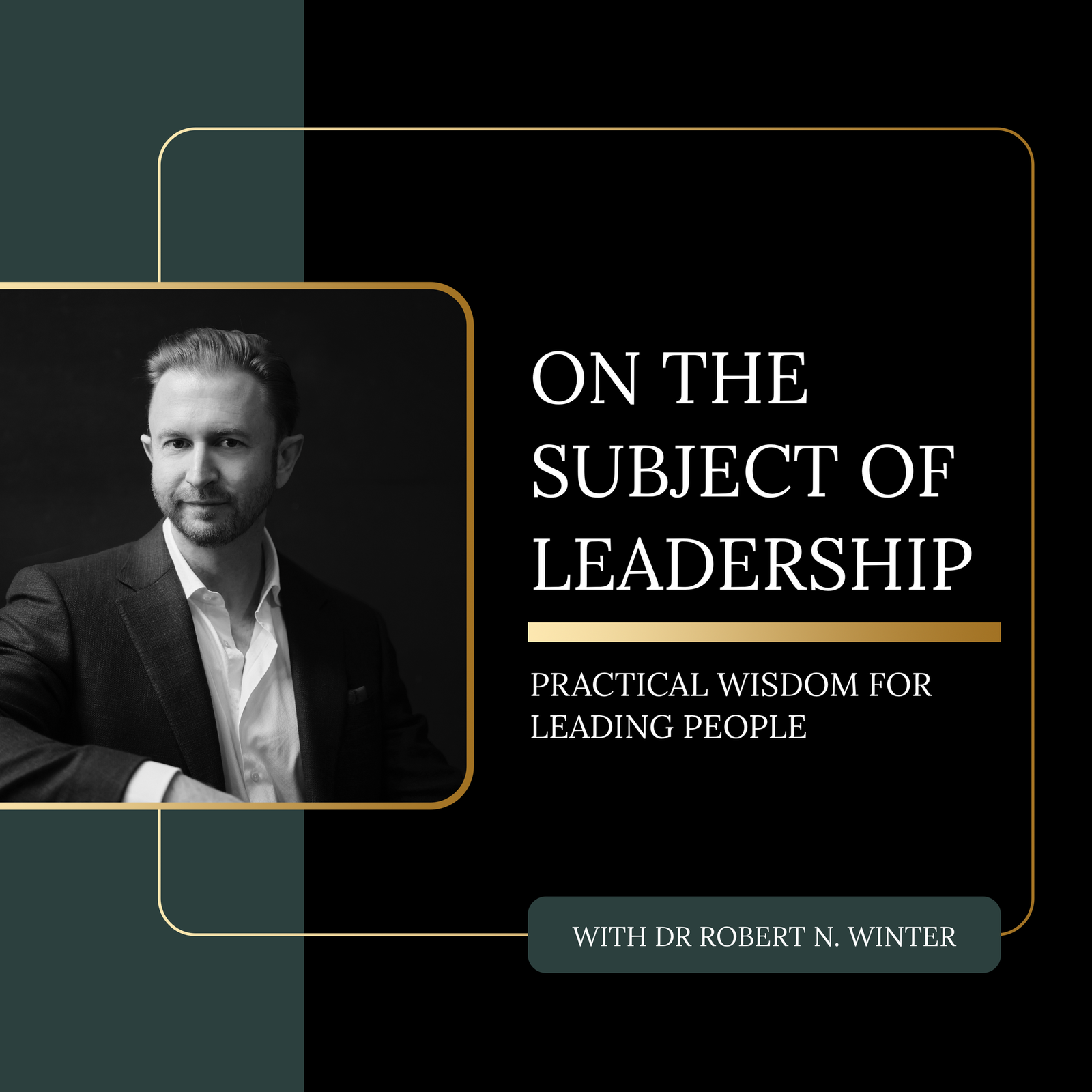
The podcast is a series of long-form conversations with people who have carried genuine responsibility: founders who built organisations under constraint, executives who learned what cannot be delegated, chairs who have watched a room turn from confident to confused when the evidence was thinner than the prose. The conversations are anchored by research—two decades of work on authority, judgment, and organisational life—but the aim is not to illustrate theory. It is to think clearly about what actually happens when authority meets reality, and why the gap between the two is so reliably wider than anyone predicted.
What the Subject Actually Is
Leadership, as a topic, suffers from the same problem Tocqueville diagnosed in democratic culture more broadly: it flattens. The pressure toward the agreeable, the inspirational, the readily shareable tends to push difficult ideas to the margins and leave the smooth ones in circulation long after their usefulness has expired. The literature is not without rigour—there is excellent work in the research on psychological safety, on upper echelons theory, on the organisational conditions that permit good judgment to function—but that rigour rarely survives the journey from journal to practice. By the time it reaches the leadership development programme, the nuance has been stripped and the headline remains.
The subject I am interested in is narrower and, I think, more tractable. It concerns the practical mechanics of authority: how accountability is actually assigned and evaded; how information is filtered as it moves upward through a hierarchy; how leaders make consequential decisions under conditions of genuine uncertainty rather than the manufactured certainty of the case study; and what distinguishes the organisations that use talented people well from those that purchase talent expensively and then proceed to waste it.
These questions are old. Thucydides was asking them about Pericles in the fifth century BC. Machiavelli asked them about the principalities of northern Italy. Burke asked them about the relationship between delegated authority and public trust. The contexts change; the underlying tensions do not. One of the things the research consistently shows—and that the best leaders consistently know—is that the problems feel new because each generation inherits them without inheriting the vocabulary for thinking about them. Part of what the podcast attempts is to recover that vocabulary, and to put it in contact with the lived experience of people who are navigating the same tensions now.
The Field Series
I think of the podcast as a field series. The research provides a map; the conversations provide the terrain. Neither is sufficient alone. A map without terrain is abstract; terrain without a map is just movement.
The guests are not chosen for celebrity or for the scale of the organisations they have run, though some have run large ones. They are chosen because their experience illuminates something specific: a particular tension between autonomy and accountability; a moment when the formal structure and the actual decision-making diverged; a lesson about what hierarchy is for that only becomes visible when it is removed. The conversations are long by the standards of the medium because the interesting material—the moment of genuine candour, the observation that contradicts the received version—tends not to arrive in the first twenty minutes.
Alongside the interview episodes sit shorter reflective pieces: essays in audio form that draw on the research and on the longer arc of thinking that runs through the written work at this site. These are occasions for argument rather than illustration—for pushing a claim until it breaks, or until it holds.
The most recent episode is below. Subscribe wherever you listen to podcasts, or follow along here.
The Ask
What I am not doing, and will not do, is manufacturing inspiration. The test I apply to every episode is not whether it sounds impressive but whether it would actually help someone choose, coordinate, or act more clearly under pressure. That is a higher bar than it might appear. Most content that sounds useful—the three habits, the five disciplines, the seven practices of whichever kind of leader is currently in fashion—fails it immediately. It sounds useful the way a tide table sounds useful to someone who has never seen the sea.
Leadership is difficult because it operates at the intersection of what an organisation needs and what the people inside it are willing to bear—and those two things are frequently not the same. Pericles understood this. So did Lincoln, who assembled a cabinet of people who disliked both him and each other on the grounds that he needed the best minds more than he needed the most comfortable room. So did every leader who has ever had to deliver a judgement their organisation was not ready to hear and had to hold the line while it was tested.
The conversations in this podcast are with people who know that difficulty from the inside. They are not triumphalist. They do not conclude that everything worked out. Some of them are about failure, or about the particular kind of partial success that looks like failure from one angle and like survival from another. What they share is the willingness to think carefully in public about what actually happened, and why.
That is, in the end, the only kind of leadership conversation worth having.
Good night, and good luck.