Most conversations about corporate governance begin with structure—committees, charters, the machinery of oversight. This one begins on the side of a dirt road in Nepal in 1999, and I make no apology for that, because the road turns out to explain the boardroom rather better than the boardroom usually explains itself.
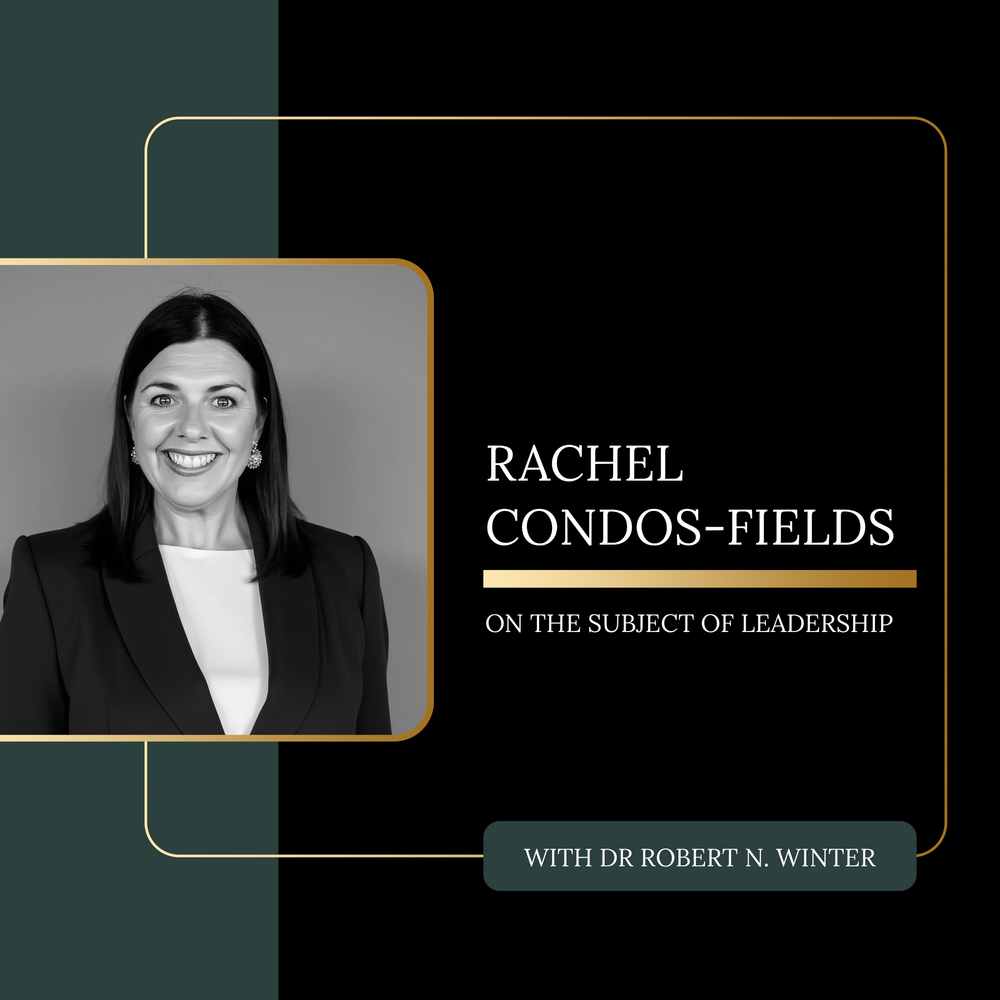
In this episode of On the Subject of Leadership, I speak with Rachel Condos-Fields OAM—Independent Non-Executive Director of Stanwell Corporation, Queensland's largest electricity generator, and founder of The WattleNest, a venture connecting corporate Australia with elite athletes.
Her career is an unusual instrument for examining where authority actually lives. She spent eighteen years at Computershare observing the boards of some of Australia's largest listed companies from the service provider's chair—watching them work without being of them—before taking a director's seat herself. She has since added the founder's chair, which is to say the one seat in the modern economy with the least authority and the most accountability of all. From that triangulated vantage point she offers a formulation she returned to twice in our conversation, which I take as a measure of its centrality: formal authority means very little without information, without culture, and without courage.
Late in the recording, she told a story that reorganised everything that had preceded it. In 1999, as a seventeen-year-old working two days a week in a bakery for six dollars an hour, she met a six-year-old boy on the side of a road—a road that did not then exist—with no path to a school fifty metres from his house. She made a decision whose consequence took two decades to arrive. In 2019, that boy, Sukra, now a man with a wife, a son, a house, and a car of his own, collected her from Kathmandu airport and drove her to her hotel. For the first time in the show's run, I was rendered genuinely speechless—a condition podcast hosts do not readily admit to, and one I have decided to treat as data.
What follows are the ideas from the conversation I have continued to turn over since.
Authority on Paper
The governance literature has spent half a century organised around a single suspicion. In their foundational analysis of agency costs, Michael Jensen (1939–2024) and William Meckling (1921–1998) framed the corporation's central problem as the divergence of interest between those who own an enterprise and those who manage it. On this account the board exists as a monitoring instrument: an apparatus of institutionalised distrust, checking that the agents do not quietly serve themselves. The competing tradition—stewardship theory, given its fullest statement by James Davis, F. David Schoorman, and Lex Donaldson in 1997—begins from the opposite anthropology: that executives are frequently motivated by achievement, identification, and intrinsic satisfaction, and that governance built entirely on suspicion forfeits the gains available from trust and empowerment.
What Rachel's experience suggests, uncomfortably for both camps, is that the choice of theory is largely beside the point. The boards she watched fail did not fail because they had selected the wrong model of human motivation. They failed because the instrument of oversight was present and the exercise of it was not. Boards, she observes, technically hold enormous power; but in practice they are not the subject matter experts, they meet infrequently, and they rely almost entirely on management for visibility into the organisation they are meant to govern. The formal structure guarantees nothing. What determines whether authority on paper becomes influence in practice is, in her account, the quality of relationships, the transparency of information flows, and a willingness to ask questions—variables that appear in no committee charter and survive few due diligence checklists.
There is a quiet heresy in this that deserves to be named. The governance industry—and it is an industry—sells structure: skills matrices, evaluation frameworks, charter reviews. All of it useful; none of it sufficient. No charter has ever asked a difficult question on a director's behalf.
The Comfort of Harmony
Rachel's diagnosis of the failing boards she observed was precise: they confused harmony with effectiveness. They ratified decisions rather than interrogated them. The phrase is her own, but the phenomenon has a distinguished pedigree in the research. In their 1999 treatment of boards as strategic decision-making groups, Daniel Forbes and Frances Milliken argued that board effectiveness turns on a delicate and largely invisible trade-off: boards need cognitive conflict—genuine, task-focused disagreement—to do their monitoring work, yet the same conflict threatens the cohesion an episodic, part-time group requires to function at all. The failing board resolves the tension by quietly abandoning the conflict. What remains looks, from the outside, like a well-functioning board. It is collegial, efficient, and unanimous. It is also, in any meaningful sense, decorative.
The question is what makes the productive alternative possible, and here Rachel's answer was unequivocal: the chair. Reflecting on her experience as a frequently young director—arriving with governance expertise but lacking the industry knowledge of everyone else at the table—she described the obligation to probe, to understand, and to ask, in rooms where every question risks advertising one's ignorance. Whether that obligation is discharged, she argues, comes down to the chair's ability to create an environment in which the naïve question is safe to ask. The research vocabulary for this arrived with Amy Edmondson's field study of work teams: psychological safety, the shared belief that the team is safe for interpersonal risk-taking, which her data linked directly to learning behaviour—asking questions, admitting uncertainty, surfacing error. That a construct developed in manufacturing teams should describe the boardroom so exactly is not a coincidence. A board is a team that meets only a handful of times a year to make consequential decisions under information asymmetry; it is, if anything, the limiting case of Edmondson's problem.
It is worth pausing on how this inverts the conventional picture. We imagine board effectiveness as a function of the expertise assembled around the table. Rachel's experience suggests it is at least as much a function of whether the least expert person in the room feels able to speak their mind and if the other directors are willing to look, listen, and act.
When Process Replaces Purpose
Asked why development organisations succeed or fail at reaching the people they exist to serve, Rachel offered a diagnosis that travels well beyond the aid sector: organisations fail when process replaces purpose. She has watched institutions of excellent intention become ineffective because they came to prioritise reporting structures and donor expectations over the lived realities of the communities in front of them.
Robert K. Merton (1910–2003) gave this pathology its classic treatment in his 1940 essay on bureaucratic structure and personality, describing the displacement of goals: the process by which an instrumental value—adherence to the rules—becomes a terminal one, so that discipline devised to serve the organisation's purpose gradually becomes the purpose. Merton's bureaucrat is not corrupt. They are conscientious. That is precisely the problem. The rules are followed with an exactness that defeats the ends the rules were written to achieve.
What Rachel adds to Merton is a claim about detection. Goal displacement, on her account, cannot be observed from inside the reporting structure, because the reporting structure is where the displacement lives. It is observed at the boundary—where the organisation touches the people it claims to serve—which is why her prescription is proximity: staying connected to lived realities, decentralising decisions, privileging relationships over transactions. One may fairly object that relationship is precisely the thing bureaucracy was invented to economise on, and that the formula does not obviously scale. However, the deeper point survives the objection. An institution that has lost contact with its boundary can comply its way into complete irrelevance and never notice; and the board that confuses harmony with effectiveness and confuses reporting with impact is exhibiting the same disease—the substitution of an internal signal for an external one.
Two Clocks
The most personally revealing passage of the conversation concerned a tension Rachel carries within her own week. As founder and chief executive of The WattleNest, she wants execution, momentum, instant progress. As a director of Stanwell, her role is to provide oversight, perspective, and challenge—to ask, as she put it, have we thought about this long enough? By her own cheerful admission an impatient person, she has had to cultivate a deliberate slowness in the boardroom that her founder's instincts resist, and which she concedes management may experience as a handbrake.
I have come to think of this as a problem of two clocks, and the underlying tension has a canonical statement. James March (1928–2018), in his 1991 essay on organisational learning, distinguished exploitation—the refinement of what is already known, whose returns are near, predictable, and attributable—from exploration, whose returns are distant, uncertain, and frequently invisible to the systems that allocate reward. His central warning was that organisations systematically favour exploitation, not through stupidity but through arithmetic: the feedback loops that govern behaviour run faster than the phenomena that matter. Rachel's observation that incentives and bonuses, whatever their virtues, do not create long-term thinking is the boardroom corollary. One need not impugn anyone's character to predict that people will manage to the clock they are paid on.
Her seat at Stanwell gives the problem an institutional twist worth examining. A government-owned corporation (GOC) operates, in her phrase, with dual accountabilities—commercial performance and public interest—its decisions evaluated through financial, social, political, and long-term economic lenses at once. That complexity slows decision-making, she concedes; but it can also create space for the longer-horizon thinking that a listed company facing continuous disclosure struggles to sustain. In a sector where investments unfold over decades rather than quarters, the GOC's structure is arguably better matched to the tempo of the thing being governed. Every governance model, she was careful to add, purchases its virtues with its own distortions: the GOC trades quarterly pressure for political accountability, and neither master is undemanding. But the general lesson stands. The question is not which governance model is best, but whose clock the model runs on—and whether that clock keeps the same time as the assets, communities, and consequences it presides over.
Staying the Distance
Which returns us to the road in Nepal, and to the question I put to Rachel near the end: what has enabled her to maintain a commitment to one community for twenty-seven years, in a civic culture where engagement is so often measured in photo opportunities?
Her answer had several layers—passion, an emotional connection that still brings her readily to tears, and a monthly hour of structured reflection she guards in her diary—but the load-bearing element was this: change does happen, but you can't see it if you're not prepared to stay the distance. The school she helped establish in 1999 had roughly twenty students, almost all boys, because the community did not then consider it acceptable to educate girls. Today it enrols around eight hundred students, some seventy per cent of them girls, with an IT college alongside. No single year in that arc would have furnished proof the effort was working. The evidence exists only in aggregate, across a span longer than most institutional attention spans—and considerably longer than most funding cycles.
Albert Hirschman (1915–2012) supplied the mechanism in 1970. Loyalty, in his framework, is what holds people in relationship with a faltering institution long enough for voice—the effort to improve it from within—to do its work; without loyalty, exit is too easy, and everything that improves slowly is abandoned early. Rachel's twenty-seven years are Hirschman's loyalty in nearly pure form: a refusal of exit sustained long past the point the interim evidence would justify, vindicated only in retrospect. And Philip Selznick (1919–2010), in 1957, gave us the vocabulary for what such commitment produces. Institutions, on Selznick's account, are organisations that have become infused with value beyond the technical requirements of the task—and the distinctive work of leadership is precisely this infusion, the slow conversion of an expendable instrument into something a community prizes for its own sake. A school in rural Nepal that has become the village's shared achievement rather than a foreigner's project is Selznick's thesis made visible, at 800 students and counting.
The obvious objection deserves a fair statement, because I pressed a version of it during the episode: patience shades easily into complacency, and the counsel to stay the distance can become an alibi for institutions that are merely failing slowly. Rachel's own practice supplies the discipline that separates the two. Her monthly hour of reflection is not sentiment but measurement—a deliberate comparison of where things stood a month ago, a year ago, at inception. Commitment without measurement is stubbornness; measurement without commitment is reporting. The combination is rare, and it may be the nearest thing to an operational definition of stewardship I have encountered on this show.
The WattleNest rests on the proposition that:
Despite being a sports obsessed Nation, over 40% of our elite athletes live on or below the poverty line resulting in 42% of our athletes aged between 18 and 34 suffering from poor mental health due to their financial predicament.
The structural observation this statistic gestures at is uncomfortable enough at any magnitude: we have built a system that extracts national prestige from individuals whose financial circumstances we decline to examine. Rachel's response has been to build a bridge between that talent and corporate Australia one relationship at a time, on the strength of a reputation assembled over thirty years. Her father told her that reputation is a shadow that follows you everywhere and never disappears. It occurred to me, listening back to the recording, that the same is true of its absence.
If you sit on a board and suspect your meetings are more harmonious than they ought to be, if you are attempting to build something whose value will not be demonstrable this quarter, or if you simply want to hear governance discussed by someone who has watched it from every chair in the room, this is a conversation worth your full attention.
Good night, and good luck.