What separates a commitment from a preference?
A preference is what an organisation would like to do. A commitment is what it has arranged to be unable to stop doing. Most corporate purpose statements are preferences written in the grammar of commitment, and the difference stays invisible until margins compress. In 2008 and 2009, a great many Australian sustainability program were revealed within a single reporting cycle to have been preferences all along. Few were repudiated. They were simply not funded, which amounts to the same thing with better manners.
This is why the interesting question about a purpose-led business is never whether the purpose is sincere. Sincerity is cheap and, in any case, unobservable. The question is what the purpose is structurally prevented from surviving, and who would have to agree before it could quietly lapse.
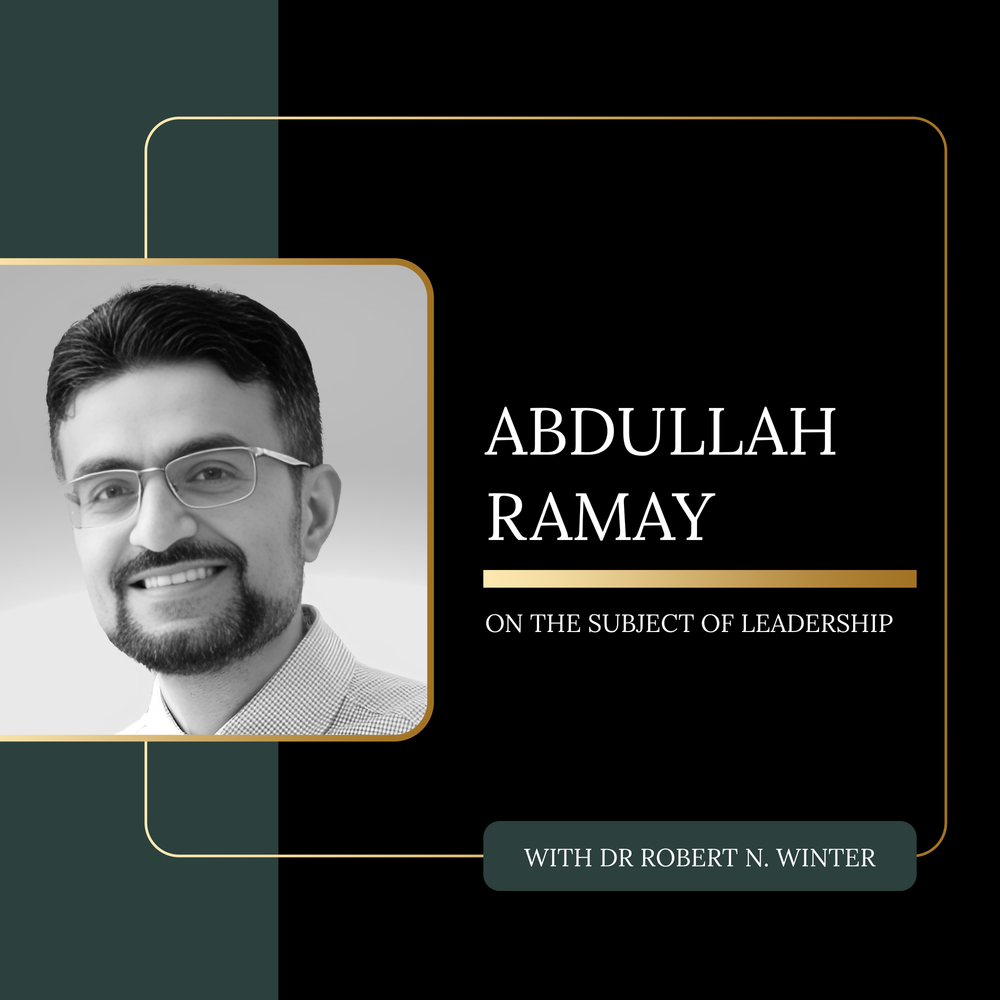
Abdullah Ramay is chief executive of Pablo & Rusty's Coffee Roasters, the Sydney specialty roaster founded in 2003 by Saxon Wright. The business has been a certified B Corporation since 2017, has held Climate Active carbon neutral certification since 2020, and is a member of 1% for the Planet—one per cent of revenue, not profit, which is a materially harder commitment and the only version of it that binds in a bad year.
What follows are the ideas from the conversation I have continued to turn over since.
Purpose is Discovered Backwards, then Argued forwards
Abdullah's account of how purpose arrived at Pablo & Rusty's is disarmingly unheroic. The people in the business liked coffee and liked the outdoors; coffee is grown outdoors; habitat loss therefore threatened both the thing they cared about and the thing they sold. Only later was any of this articulated as purpose. "It was organic at first," he said, and the sequence matters more than the modesty of the telling.
He then offered five questions for organisations trying to choose a purpose: what problems do you deeply care about, how does it connect to your business model, does it resonate with customers and stakeholders, can you meaningfully contribute, and are you willing to commit to it for ten years. He credited the framing partly to ikigai.
A note on that, since it bears on the argument rather than merely on provenance. The four-circle diagram that circulates as ikigai—what you love, what you are good at, what the world needs, what you can be paid for—is not Japanese and was not originally about ikigai. It was drawn by the Spanish author Andrés Zuzunaga in 2011 under the label propósito, and relabelled by a British blogger in 2014. The serious scholarship belongs to Mieko Kamiya (1914–1979), the psychiatrist who developed her account of ikigai while working with leprosy patients at the Nagashima Aiseien sanatorium, published as Ikigai ni tsuite in 1966. Kamiya distinguished ikigai—the object that makes life worth living—from ikigai-kan, the felt sense of it. Her subjects had no vocation, no market and no payment. Whatever she was describing, it was not career optimisation.
Which is awkward for the diagram and rather good for Abdullah's actual position. His five questions do not really function as a selection procedure. Read honestly, four of them are tests you apply to something you have already noticed about yourself; only the fifth costs anything. Any board can answer the first four in an afternoon and produce a statement that survives contact with nothing. The ten-year question is the only one with teeth, because it is the only one that asks the organisation to give up an option.
Authenticity is not a Market Position
Abdullah defines authenticity as consistency between internal thought and value on one hand and external speech and action on the other. He then names the paradox precisely: organisations pursue authenticity because authenticity is admired, and the pursuit is self-defeating for exactly that reason. His resolution is that authenticity matters first for the organisation itself, because the organisation knows.
Erving Goffman (1922–1982) would take the first half of this and decline the second. The Presentation of Self in Everyday Life, published as an Edinburgh monograph in 1956 and expanded for the Anchor edition of 1959, argues that conduct is organised into front and back regions, each with its own audience and its own performance. The back region is not where the mask comes off; it is where a different one goes on. On Goffman's account there is no unperformed self to be consistent with, which puts considerable weight on "the person knows".
The organisational version travels better than the individual one. An organisation has no interior life, but it does have employees, and employees are the standing audience of the back region. What Abdullah is really claiming is that the gap between the external message and the internal decision is observed continuously by the only people positioned to see both—and that this observation, accumulated, is what culture is. That is a far stronger claim than it first sounds, and it is testable in a way that individual sincerity is not.
It also explains why consumer scepticism about sustainability claims is rational rather than cynical. Organisations copy one another's legitimacy signals; a customer who assumes a sustainability claim is imitation is usually right on the base rates.
Then there is the packaging decision, which is the most concrete thing in the hour. Pablo & Rusty's considered moving coffee bags to paper, judged the option marginally more sustainable, and refused it because it degraded the product. Abdullah frames this as core value first, purpose built on top, and the hierarchy is stated openly rather than smuggled.
But it should be named for what it is. That is a case where purpose lost. It demonstrates that the hierarchy is honest; it does not demonstrate that the purpose binds. The decision that would prove the commitment is the mirror image—a case where the environmental constraint held against a clear commercial interest, and someone in the business was made worse off for it. Certification and revenue tithing suggest such cases exist. The conversation did not surface one, and I did not press hard enough for it.
What Actually Binds a Board
Abdullah's argument for certification is unsentimental. Consumers standing in a supermarket aisle cannot audit a supply chain; the information asymmetry is total and the transaction cost of resolving it is absurd. Certification outsources the verification, and recertification cycles keep the organisation honest over a period longer than any executive's tenure. This is a commitment device rather than a marketing asset, and he is clear that it is the recurrence, not the badge, that does the work.
The limitation is worth stating alongside the argument, because it is the one certification cannot resolve. A badge does not eliminate the asymmetry; it relocates it. The consumer who cannot audit a supply chain equally cannot audit the standards body, and is now trusting an institution whose incentives run toward growing the number of certified firms. Recertification protects against drift within a fixed standard. It does nothing about movement in the standard itself, which is a governance question about the certifier rather than the certified, and one that very few boards ask before signing up. That the mechanism is imperfect is not an argument against it—the counterfactual is unverified claims—but it does mean certification substitutes a better-governed trust for an ungoverned one rather than replacing trust with verification.
He then made a legal claim worth examining. Before B Corp's requirement that companies amend their constitution to weigh all stakeholders, he suggested, a listed company going above the statutory redundancy minimum might be breaching its duty to maximise shareholder value.
Lynn Stout (1957–2018) spent much of her career demonstrating that this is not what corporate law says. The Shareholder Value Myth (2012) argues that shareholder primacy is a managerial norm that acquired the costume of a legal obligation, and that the obligation it imitates does not exist. In Australia the position is at least as favourable: section 181 of the Corporations Act 2001 (Cth) requires directors to act in good faith in the best interests of the corporation. Authority on what that phrase encompasses is genuinely divided, and I would not represent the matter as settled—but no provision requires share-price maximisation, and the Governance Institute's own commentary holds that boards need not lose sleep over the question.
The correction is not pedantry, because the error is load-bearing. A director who believes she is legally barred from doing something she is in fact permitted to do will not do it, and the belief will have done the work of the law without any of its scrutiny. Which is the strongest available argument for the constitutional amendment Abdullah favours—not that it changes what directors may do, but that it removes the alibi. A statutory minimum is a floor, not a ceiling. Most organisations treat it as a ceiling and describe the choice as a constraint.
Seven out of Ten, and the Arithmetic underneath it
On delegation, Abdullah was more specific than most executives are willing to be. His organisation teaches decision frameworks before it delegates decisions, distinguishes reversible from irreversible choices, and tells people plainly that it is aiming to get seven or eight decisions in ten right. Waiting for perfect information is itself a decision, and usually a worse one.
Herbert A. Simon (1916–2001) named this in Administrative Behavior in 1947: the administrator does not maximise, because he cannot; he satisfices, searching until an option clears an acceptable threshold and then stopping. What is unusual here is not the practice—every organisation satisfices—but the publication of the threshold. Announcing an accuracy target changes what an error means. It converts individual failure into expected variance, which is a more robust foundation for psychological safety than any amount of encouragement, because it does not depend on the temperament of the manager on the day.
The obvious question is what sits in the denominator. Seven out of ten is a ratio without a population, and an organisation can be right on eighty per cent of its reversible calls while being wrong on the single irreversible one that matters. The one-way and two-way door distinction exists precisely to insist the two classes be scored separately; a blended figure quietly undoes it. I suspect Pablo & Rusty's does treat them separately—Abdullah described exactly that escalation logic—but the headline number obscures it, and headline numbers are what travel.
The Job Description as a Wasting Asset
The most useful thing Abdullah said about work was structural rather than motivational. Roles on the technological frontier now change materially every two or three years, and elsewhere every five to seven. The consequence he draws is unsettling and correct: change is no longer something a role undergoes, it is a component of the role. What you were hired to do is not what you will be doing, and treating the adaptation as discretionary effort—going above and beyond—misdescribes the job.
Edith Penrose (1914–1996) gave us the distinction this rests on. In The Theory of the Growth of the Firm (1959) she insisted that resources are never the inputs to production; the services resources render are, and those services are a function of how the resource is used. The same person is a different input in a different configuration. Cross-skilling, in Penrose's terms, is a deliberate attempt to keep the services loose from the resource, so that capability can be redeployed when demand moves rather than left stranded in a function that no longer needs it.
Abdullah follows the logic where it goes, which is to reward. If the compensable attribute is no longer the skill but the capacity to acquire and relinquish skills, then remuneration has to price that. Most organisations want the flexibility without repricing it, and the gap between those two positions is where cross-skilling degrades into unpaid role expansion. He said the downstream consequences run to hiring, training and reward. Whether Pablo & Rusty's has actually changed what it pays for, as opposed to what it asks for, is the test of the position, and it is the question I would put to him next.
The role half-life figures, incidentally, were offered as impression rather than measurement, and should be treated that way.
The Leader Tires before the Market Does
The observation I have returned to most is the one about repositioning. An organisation spends two or three years on a new position; the market is just beginning to register it; new leadership arrives, or the incumbents simply exhaust themselves on their own message, and the whole thing is abandoned at the moment it starts to work. The failure is not analytical. It is that the people delivering the message heard it several thousand times more often than the audience did, and mistook their own fatigue for market indifference.
Philip Selznick (1919–2010) built a theory of leadership around precisely this problem. Leadership in Administration (1957) distinguishes the organisation as a technical instrument from the institution as something infused with value beyond the task at hand, and locates the leader's distinctive work in maintaining that character over time. Efficiency is delegable; institutional maintenance is not. On Selznick's reading, repetition is not the overhead of the strategy. It is the strategy.
Abdullah's remedies are modest and, I think, honest for it: circulate the wins that actually evidence the purpose, use quarterly review to reflect rather than only to measure, encourage people to keep a personal record of what they have achieved because the plateau is invisible from inside it. He was candid that the firm is still working this out, and candid that his own view is that the pace will not slow. If that is right—and I think it is—then the adaptation cannot be to the volume of change but to how it is carried, which is a much less satisfying conclusion than a program.
He also declined the work-life separation on the grounds that it is all just life, which is either a genuine insight about how people actually allocate attention or the most durable rhetorical device in modern management. It is probably both, and the difference is only visible in what an organisation does at eight o'clock at night.
Who Should Listen
Directors weighing whether a purpose commitment in their own organisation is binding or ornamental, and who would benefit from a clear account of what a constitutional amendment does and does not achieve. Executives who have been handed decision rights without a decision framework, which is most of them. Anyone currently drafting a purpose statement, who should skip the first four questions and start with the tenth year.
Good night, and good luck.