Good evening, and welcome to the second edition of The Scribbler. A newsletter featuring an expanded set of articles addressing a key challenge facing organisations. This month I am taking a look at the risk AI poses to proxies. But first, a bit of trivia...
Trivia question: In 1940, for her performance in Gone with the Wind, what was the name of the woman who became the first African American to win an Academy Award? Answer at the bottom.
This Edition's Scribbling
To cope with the torrent of data and decisions we must deal with in our daily life, we use a series of heuristics or proxies to reduce the cognitive load. In the space of organisational behaviour, this is a process that tends to become more prevalent the higher the org chart we climb. The reason for this is that the Executive Leadership Team or Board of a large organisation could have tens of thousands of specialists working for them and it is impossible to be across the detail of all their work. To prevent analysis paralysis, proxies play a vital role in formulating the myriad complex parts into a conceptualisation about which a decision can be made.
George Pólya's 1945 book, How to Solve It outlined a series of commonly used proxies:
- Visualisation: if you struggle to comprehend something, sketch it.
- Start at the end: if you cannot formulate a solution, begin with the end in mind and see if you can work backwards.
- Give examples: if you find abstract concepts difficult, find a concrete example.
While these techniques can be used to great effect in decision making, they also bring their own range of problems. Key among which is that we make poor decisions if our proxy does not give an accurate representation of the problem / opportunity / reality.
With the rise of AI, or Large Language Models (LLM) to more accurately name most of the services such as ChatGPT you are encountering, what could be termed the 'problems with proxies' is becoming more prevalent. The reason is that, as Ted Chiang put it in an article for The New Yorker, most 'AI' is:
a blurry jpeg of all the text on the Web. It retains much of the information on the Web, in the same way that a jpeg retains much of the information of a higher-resolution image, but, if you're looking for an exact sequence of bits, you won't find it; all you will ever get is an approximation.
To counter this failing, systems use modelling to fill in the gaps and sharpen the image. This leads to an output which is plausible enough to seem true to an untrained person, but falls short of what would have been achieved by an expert with better knowledge of the subject matter.
This is certainly not to dismiss the increasing value that AI is steadily bringing to organisations. Something I argued is a key strategic opportunity in Leading AI-First Organisations. Rather, it is to call attention to what will initially seem like an ever improving 'quality' in report writing, lulling line managers into a false sense of security and ultimately undermining the eventual decision making by Executives and Boards.
Until true AI begins to replace the thinkers in organisations with sentient machines, there is no replacement for the brilliance of a well-trained human mind. A reality that now, more than ever, places our people at the centre of all we do.
If line managers fail to grasp this and let employees with a distracted or tenuous grasp of subject leverage AI to serve up unverified reports, senior decision makes will end up leading their organisations on the strength of a blurry image of a blurry image.
Article Selection: Thinking on AI
Leading AI-First Organisations
By employing leaders capable of creating an AI framework — because they are awake and aware to the unintended effects of AI on social well-being, data integrity and privacy, diversity, and governance — organisations seeking to transform into being AI-first are well positioned to engage in trustworthy and responsible AI use.
 Dr Robert N. Winter
Our Mind is a Blurry Image of Life
The hope is much, for having gotten this far is to be forewarned and thus forearmed. In that we do well to employ scepticism when listening to a human interlocutor. Because even the best of us are filling in the blanks in our memory.
 Dr Robert N. Winter
Ghost Writers: Rise of the Machines
Ultimately, I do not think the problem is that we are building machines so ‘smart’ that their output is indistinguishable from human compositions. The problem is that we are educating humans whose output is so illiterate, and devoid of experience, it is indistinguishable from computer generated text.
 Dr Robert N. Winter
Art and About
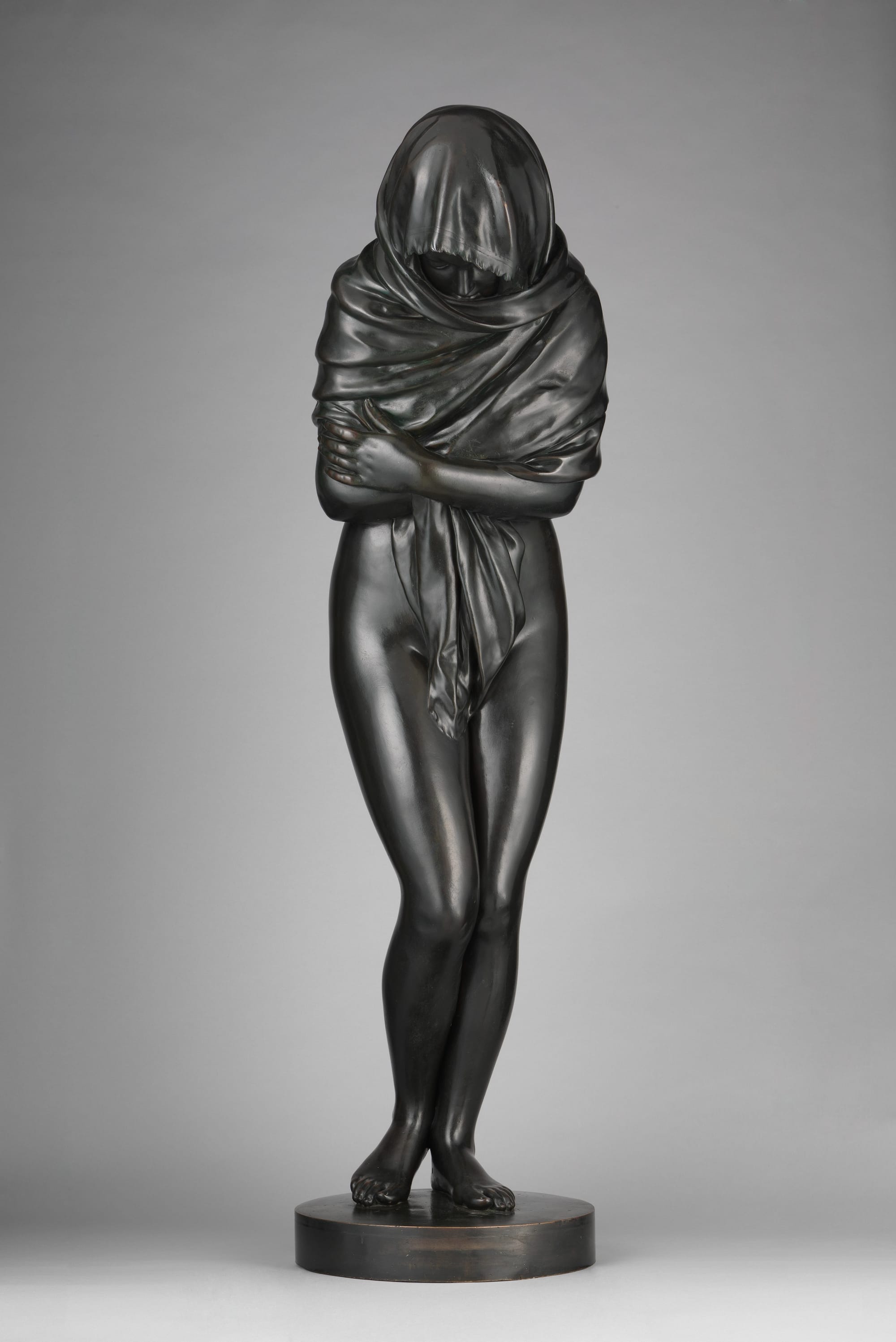
Emotional Contagion is the tendency to feel what it appears someone else is experiencing. In examining this condition in art, we have Winter (1787) by Jean Antoine Houdon (1741–1828).
Though a bronze statue, viewing it conjures a shared feeling of cold as the young woman huddles beneath her inadequate shawl. The abraded surface of the bronze adds to the sensation of cold as it makes the piece shimmer like ice.
The work is also arresting for its departure from traditional representations of Winter as an old man.
Image © +The Metropolitan Museum of Art
Neuroscience research source: Cooper EA, Garlick J, Featherstone E, Voon V, Singer T, et al. (2014) You Turn Me Cold: Evidence for Temperature Contagion. http://journals.plos.org/plosone/article?id=10.1371/journal.pone.0116126.
Trivia Answer
Trivia question: In 1940, for her performance in Gone with the Wind, what was the name of the woman who became the first African American to win an Academy Award.
Answer: Hattie McDaniel.
Additional Trivia: Most of Atlanta's 300,000 citizens crowded the route of the seven-mile (11 km) motorcade that carried the film's other stars and executives from the airport to the Georgian Terrace Hotel, where they stayed. While Jim Crow laws kept McDaniel from the Atlanta premiere, she did attend the film's Hollywood debut on December 28, 1939. Upon Selznick's insistence, her picture was also featured prominently in the program.
She has two stars on the Hollywood Walk of Fame, was inducted into the Black Filmmakers Hall of Fame in 1975, and in 2006 became the first Black Oscar winner honoured with a U.S. postage stamp. In 2010, she was inducted into the Colorado Women's Hall of Fame.
To read more about the life of Hattie McDaniel, see Jackson, Carlton (1989), Hattie: The Life of Hattie McDaniel. Rowman & Littlefield.
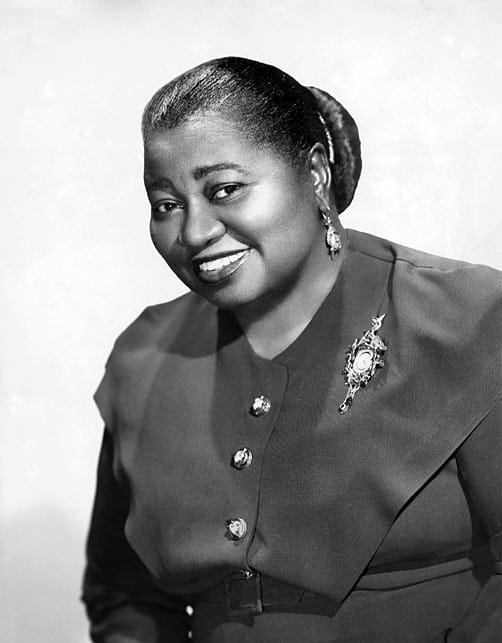
Hattie McDaniel (1939) is licensed under Public Domain.