
Last year, I undertook a piece of research for what became Governing Digital with Courage and Clarity, a report on how directors should oversee AI, data, and the broader digital portfolio at the board table. The methodology was unremarkable. I interviewed chief executives, non-executive directors, and AI consultants across across a range of sectors. Most spoke on the record. Ed Santow—Co-Director of the UTS Human Technology Institute and a member of the Australian Government's AI Expert Group—was characteristically generous with his time and characteristically clear in his assessment, as were a number of others who saw the landscape accurately and were happy to be named.
A handful of contributors, however, spoke only on the condition of anonymity.
This is common enough in research. People who are about to expose an inconvenient truth often want some distance from the consequences of having exposed it. What was unusual on this occasion was that the anonymity was sought for the opposite reason. These contributors were not exposing a truth. They were insisting on a convenient lie.
Every interviewee was sent the final draft before publication. The only critical feedback I received came from one or two of those anonymous voices, who took particular exception to my finding that organisations were, in aggregate, failing to translate AI investment into measurable financial uplift. I noted that the major industry research was arriving at the same conclusion. They replied that those surveys were "several months old, and AI is moving too fast for them to be reliable."
This is the half-lie that runs through the entire executive conversation on AI, and it deserves to be named clearly because it is doing an extraordinary amount of work in keeping the present arrangement in place. AI is indeed moving fast at the level of model capability. It is not moving fast at the level of enterprise value capture, which is the level that matters to a board, to its shareholders, and to the broader community. The conflation of the two is the convenient lie, and it provides perfect cover for the executive who cannot deliver and is unwilling to have that conversation with the people to whom delivery has been promised. Lying outright would be too easily falsified. The half-lie is harder to dispatch because half of it is true. The trouble with this is that those who tell lies are merely concealing the truth. Those who tell half-lies have forgotten where they put it.
The data, when assembled longitudinally, settles the question.
Nine years ago, MIT and the Boston Consulting Group surveyed three thousand executives about artificial intelligence and found that just one company in twenty had extensively incorporated AI into its products or processes. The other nineteen had budgets, ambitions, and a shared sense that the matter was urgent. They had not, on close inspection, done very much.
Last month, Deloitte released the 2026 edition of its annual State of AI in the Enterprise survey—3,235 senior leaders across twenty-four countries. The headline findings were jubilant. '84% of organizations increasing their AI investments and 78% of leaders reporting greater confidence in the technology.' Three-quarters of companies plan to deploy autonomous AI agents within two years. AI confidence sits at record highs.
Then one reads the rest of the report. Twenty per cent of organisations are growing revenue through AI—but don't worry, seventy-four per cent hope to. Eighty-four per cent have not redesigned a single job around the technology that is supposedly reshaping their business. Twenty-one per cent have a mature governance model for the autonomous agents that three-quarters intend to deploy. And only one organisation in four has moved forty per cent or more of its AI experiments into production—but again, don't worry, 54% expect to.
After nine years and hundreds of billions invested, the numbers have moved, but the delta between measurable reality and ambition remain stubbornly the same. What has increased, and increased dramatically, is the ever widening gap between the price to earnings ratio.
McKinsey's 2025 survey of nearly two thousand organisations found that only six per cent qualified as AI high performers by the standard of attributing five per cent or more of EBIT impact to AI and reporting significant value from it. A figure essentially unchanged from MIT and BCG's 2019 finding that ten per cent of companies obtained significant financial benefits from artificial intelligence—for those reading those numbers closely you are correct, the number has actually gone down. The technology around these numbers has moved through several generational shifts. The ROI numbers have not. The anonymous contributors who told me that the surveys were stale were not, in fact, mistaken about the speed of AI. They were gravely mistaken about which speed mattered.
Anthony Trollope (1815–1882) had a word for this sort of thing. The Way We Live Now, published in 1875, concerned itself with one Augustus Melmotte, a financier of obscure origin who arrived in London at the head of a great speculative scheme: the South Central Pacific and Mexican Railway. The railway, Melmotte assured everyone, would be enormously profitable. The railway would transform commerce between two oceans. The railway, in due course and after a great many dinners attended by the higher orders of London society, turned out not to be a railway at all but a sequence of prospectuses, shareholder lists, and confident assurances that construction was proceeding according to schedule somewhere in Mexico, where no one of social consequence could be expected to verify it personally.
Trollope's interest was not in Melmotte as such—the financial frauds of the 1860s and 1870s were numerous enough to provide ample material—but in why London found Melmotte so convincing. The duchesses, the parliamentarians, the established bankers who lent against shares in a railway no one had inspected: these were not stupid people. They were people who had agreed, by a process of mutual social reinforcement, that Melmotte was the future and that to question him was to mark oneself as provincial. The dynamic that business literature would later term the "romance of leadership" was already in fluent operation. The fraud was not located in any single conversation but in the aggregate of all of them. Trollope's title carried no irony. This was indeed how they lived now.
The institutional pattern is recognisable. I have argued elsewhere, in a forthcoming essay on what I have come to call the saviour industrial complex, that contemporary executive practice rests on a particular kind of fraud: the substitution of expensive acquisition and confident signalling for the patient development of organisational capacity. The saviour is appointed. The artisan is not trained. The wall still leans. AI, on the longitudinal evidence, is the largest and most consequential instance of the pattern yet attempted. Trillions of dollars in projected value have been promised to a technology that is, in the great majority of cases, producing efficiency improvements indistinguishable from what an additional competent clerk and a spreadsheet would have produced in 2002.
What follows in this series is an attempt to make the case empirically rather than rhetorically. There are three numbers that, set against their historical counterparts, expose the shape of the problem with some clarity.
The first is the scaling number. Twenty-five per cent of organisations have moved forty per cent or more of their AI experiments into production. Fifty-four per cent expect to do so in the next three to six months. That expectation has appeared, in some form, in essentially every major AI survey for nine years, and the production figure has barely moved. The pilot has become permanent—not because the technology cannot be scaled but because the institutional work of scaling is harder, slower, and less politically rewarding than the institutional work of piloting and promising the future.
The second is the transformation number. Thirty-four per cent of organisations report deeply transforming their businesses through AI. Eighty-four per cent report no redesign of jobs around AI capabilities. These two findings, in the same survey, cannot both be true in any operationally meaningful sense. One of them is theatre—and it isn't the 84% reporting no redesign of jobs.
The third is the governance number, and the financial number that depends on it. Seventy-four per cent of companies plan to deploy autonomous agents within two years. Twenty-one per cent have a mature governance model for them. Six per cent of organisations, by McKinsey's measure, capture meaningful EBIT impact from AI of any kind. These are not three different findings. They are the same finding expressed in different vocabulary, and the institutional incapacity they describe is the load-bearing element of the entire pattern.
The question worth putting to any chief executive making confident claims about their organisation's AI position is not whether they have a strategy, or whether they have invested adequately, or whether they have appointed the right consultants. It is whether their organisation has, in the last twelve months, done anything that the 2017 MIT survey would not have recognised as ordinary practice. The honest answer, for most, is no. The signal has changed enormously. The substance has barely moved at all.
Melmotte, in due course, was found out. The South Central Pacific and Mexican Railway never reached Veracruz, the shareholders lost their money, and Melmotte himself attended a final dinner in his honour at the House of Commons before going home to take a fatal dose of prussic acid. Trollope, who was a moralist before he was a novelist, was not interested in the prussic acid. He was interested in the dinner—the long, ceremonious dinner attended by men who had known for months what was about to happen and had elected, for reasons of social comfort, not to say so.
The dinner, in the AI sense, is still being served. The question, for anyone serious about AI leadership, is are you going to keep dining or leave the fine dining experience for the actual work of delivering value for stakeholders.
Good night, and good luck.
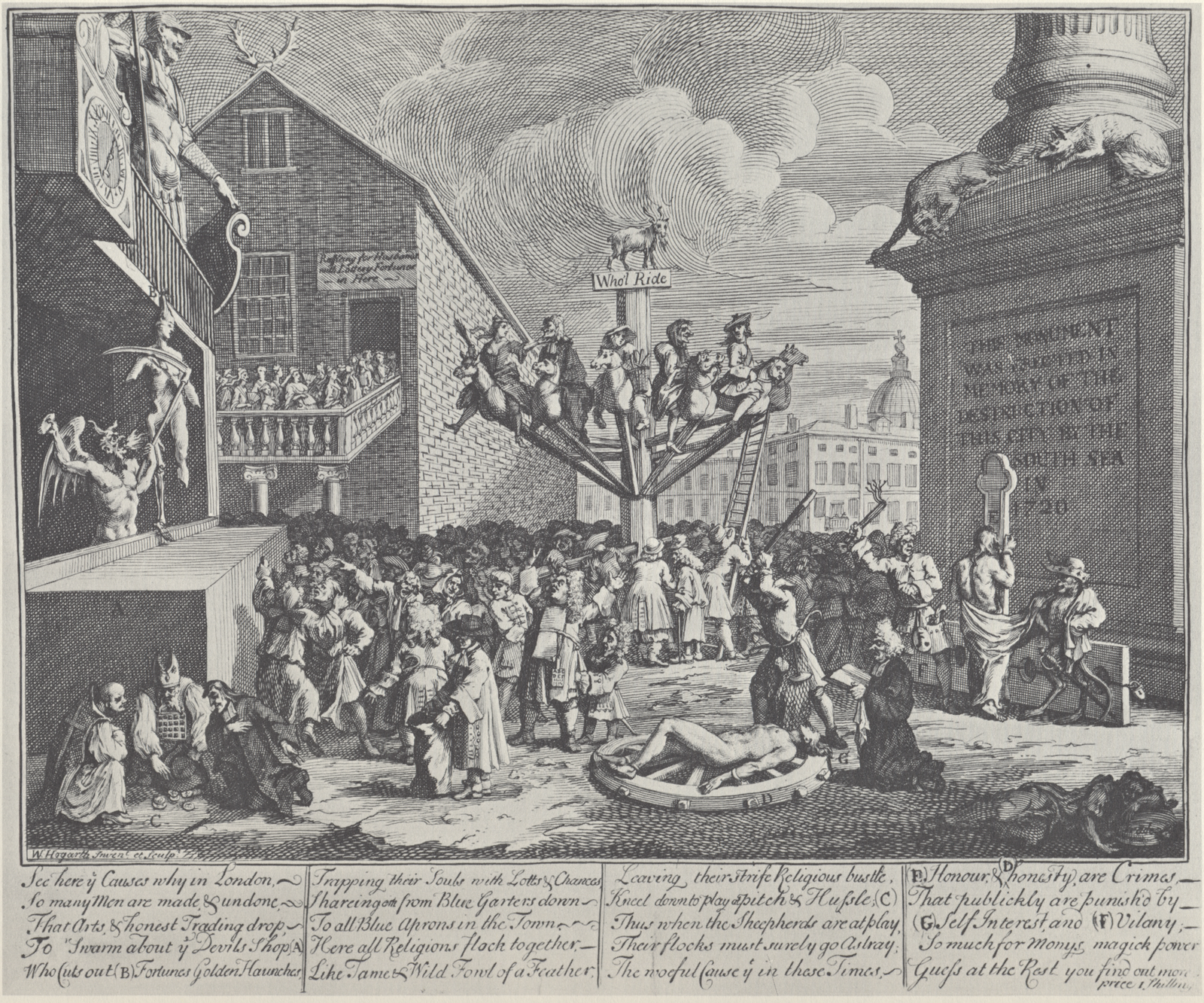
The South Sea Scheme (1721) by William Hogarth is licensed under Public Domain.





Member discussion