Mastodon Skip to content

Professor Alistair Noble: A University Is For Saving the World

Professor Alistair Noble: A University Is For Saving the World

The Commonwealth supplies less than half the revenue of Australia's universities and sets very nearly all of their terms. That sentence is not a complaint. It is a description of an arrangement we have never argued about directly, because we have been busy arguing about its instruments instead—fees, caps, student numbers, research block grants, subjects taught. Each of those debates settles a question about what universities are for without ever putting the question itself to a vote. Price a humanities degree high enough and you have made a claim about the worth of the humanities. You have simply made it with a spreadsheet rather than an argument, which has the advantage of being difficult to rebut and the disadvantage of being difficult to overturn.

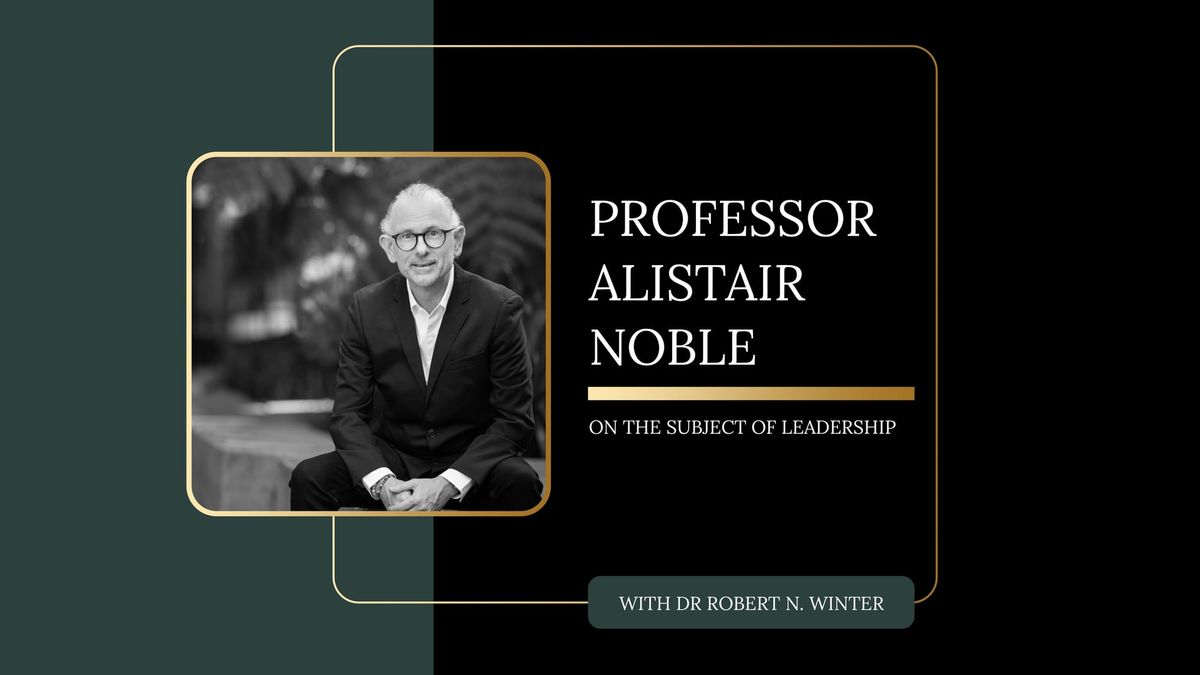
My guest this week is Professor Alistair Noble, President of Nan Tien Institute, a small independent higher education provider near Wollongong grounded in Buddhist values. Before that he spent five years as Head of School for Humanities, Arts and Social Sciences at the University of New England, and before that held roles at the Australian Institute of Music and the Australian National University. He is also a pianist, composer and musicologist; his monograph on Morton Feldman argued that music long assumed to be intuitive was in fact built on deliberate hidden structure, and his album Solarisation was released this year. In February 2025 he published an essay in the Australian Humanities Review titled Burning Questions and the Creative Imaginary: Our Humanities in Australian Regional Communities. A piece that is considerably more vehement than its title suggests.

What follows are the ideas from the conversation I have continued to turn over since.

Prestige is a Machine that Runs on Itself

We began where the sector's self-image begins: with rankings. Noble has worked inside the large public research university, the private specialist college, the regional university and the small independent institute, which gives him something very few people writing on Australian higher education possesses—comparative evidence from inside the different types of institution. His observation was that on measures of student experience, some of the best teaching in this country may be happening in the private sector, while the prestige and the international rankings accrue to institutions whose advantage is research volume and student numbers.

This is not a paradox. It is a mechanism, and it was named nearly sixty years ago. Robert K. Merton (1910–2003) and Harriet Zuckerman called it the Matthew effect: recognition flows disproportionately to those who already have it, so that eminence compounds independently of any fresh contribution. Merton was describing individual scientists, but the logic scales without modification to institutions. A large university produces more papers; more papers mean more placements in high-ranking journals; higher rank attracts stronger staff and more international fee revenue; that revenue funds more research. Nothing in the loop is a measurement of teaching quality—or even student outcomes. Nothing in the loop needs to be.

Noble pushed this further than I expected, into territory his essay only gestures at. The deference is not merely to size, he argued, but to empire. Australian hiring panels still treat an Oxford or Cambridge degree as trumping any domestic equivalent, and have grafted onto that an equivalent reverence for the American Ivy League, while the great Japanese and Taiwanese universities are not weighed in the same scale at all. The prestige hierarchy we operate is not a quality ranking that happens to correlate with history. It is a colonial inheritance wearing the costume of a quality ranking.

I find this persuasive and I notice what it costs. If prestige is largely cumulative advantage, then the sector's league-table anxiety is a competition for a position that measures mostly the durability of a position. The awkward corollary is that a great many academics have built careers on the strength of that signal, and the argument that the signal is hollow is one that challenges the entire edifice of status and rankings.

Cumulative advantage operates on places as readily as on people, which is where Noble's regional argument enters. He treats "regional Australia" as a cultural imaginary—a category defined in capital cities, for capital-city purposes, and then mistaken for a description of the world. The definitions are instruments, built to gather data or allocate funding, and the harm comes when we forget that and slip into the binary of metropolis and everything else. His warning is that the binary is false in both directions, and that the reality is a set of overlapping, intersecting communities that the neat boxes of public discourse cannot hold.

Then he said something I did not expect and have kept returning to. A well-funded institution arriving in a regional town is often the largest employer and a genuine catalyst; he cited summer schools in painting and music whose effects were still visible in whole industries decades later. But it can also stifle the cultural life already there. Every country town in Australia, on his account, holds a few people who are remarkable—a musician, a composer, a dance teacher—and the ecosystem they constitute is not the university's creation and can be crowded out by it.

Against the comfortable belief that talent will out, he was firm: it will not, not reliably. Someone has to notice, and say to a particular young person that this is something they could take further. Absent that intervention the talent is simply never converted. The Matthew effect, again, and at its least forgiving—advantage accrues where advantage already sits, and the counterweight is not a policy but a person paying attention.

The Point at Which More Stops Working

The second movement of the conversation concerned scale, and here Noble reached for a source I had not anticipated. He invoked Joseph A. Tainter, whose The Collapse of Complex Societies argues that societies fail not from external shock but from the diminishing marginal returns of their own complexity. Tainter's claim is that complexity is a problem-solving strategy with costs, and that a point arrives at which each additional increment of administration, coordination and process returns less than it consumes. Noble's suggestion was that Australian higher education is at approximately that point: we throw more at it, and it delivers less.

Set against a sector where some institutions approach one hundred thousand enrolments—a scale at which, as Glyn Davis has observed, an institution is barely recognisable as a scholarly community—the diagnosis has force. But the more interesting move was Noble's refusal of my framing. I had put the trade-school question to him directly: at that scale, does the university degenerate into a place one attends to acquire a saleable technique? He declined the terms. Universities, he said, have always been better at preparing people for careers than the current political narrative admits. The real question is not whether we have become too vocational. It is what we are losing.

What we are losing, on his account, is whatever cannot be delivered to a room of two hundred. He set the industrial lecture against the other extreme he knows from music—the one-to-one conservatoire lesson, with its own pathologies, but with an irreplaceable quality of attention. Between those poles sits the seminar, and the seminar is what scale erodes first because it is the most expensive thing per student the university does.

This is the better argument, and I concede it displaced mine. The vocational frame invites a fight about the dignity of employment that nobody needs to have. The attention frame identifies something specific and capable of being lost.

The Conversation, and what Replaces it

If the loss is a form of attention, it is worth being precise about what that attention was for. Michael Oakeshott (1901–1990) is the most useful guide here, and the least sentimental. In his 1950 essay on the idea of a university, Oakeshott described the university not as a place where information is transferred but as a conversation between modes of understanding, and the education it offers as an interval—a period deliberately protected from the demand that one be immediately useful.

Oakeshott is easy to misread as nostalgia, and the reading is wrong. His argument is structural. The conversation is not decoration on top of the training; it is the thing that makes the training more than technique, because it is where a student learns that their discipline is one way of thinking among several and therefore has edges. Noble made the same point from a different direction, quoting a linguist friend: a language is not merely a means of communication but a technology of thinking, so that when a language dies a way of thinking dies with it. A discipline, he argued, is a knowledge system in exactly that sense. Which converts the defence of unfashionable fields from sentiment into something closer to risk management—a portfolio argument about the range of problems a society retains the capacity to think about.

I pressed him on what this implies. Noble's own essay makes a sharper charge than he made on air: that public figures claiming the humanities do not lead to careers are not mistaken but lying, and they know it. He did not repeat the accusation in conversation, and I did not force it. But the two claims sit oddly together. If the case for the humanities is that they produce a distinctive capacity to think, that case is not answered by graduate employment statistics—and answering with employment statistics, which is what the sector reflexively does, concedes the vocational frame in the act of disputing it.

Trust is the Missing Input

The governance material was the most uncomfortable stretch of the hour, in the productive sense.

Noble put a figure on the table: government provides something under half of Australian university funding, yet behaves as the majority shareholder, and does so at a moment when the pendulum is swinging hard towards centralised regulation. On compliance he was crisp—it is the price of doing business, a baseline, and not to be confused with quality. His broader argument was for a diversity of institutional models, lighter-touch, with room to try things.

Then he closed the door on his own argument, and did it honestly. Could a lighter-touch settlement work? Not now, he said. The trust is not there. SUccessive Governments have doubted universities' capacity to govern themselves, and the doubt is not baseless: he described a governance system in which chancellors and vice-chancellors come and go while the same dysfunctions persist, which points to something systemic rather than personal—what I have described elsewhere as Hiring a $200 Hammer. He also observed, unprompted, that most regulation in education exists because something bad happened first.

So the position is: we need less regulation; the regulation exists for cause; and the institutions seeking relief lack the standing to be trusted with it. I do not think that is incoherent, but I do think it is unfinished, and this is where I would press hardest if we had another hour.

Elinor Ostrom (1933–2012) spent a career on precisely this problem in other domains. Governing the Commons demonstrated that shared resources are frequently governed well by their users, without either privatisation or central control—but her finding was never that monitoring is unnecessary. Ostrom's durable arrangements consistently featured monitoring that was credible, graduated in its sanctions, and accountable to the people governed rather than to a distant authority. The lesson for Australian higher education is not less scrutiny. It is scrutiny of a different design: locally legible, proportionate, and answerable downward to students and communities rather than upward to Canberra alone.

That reframing does something for the sector's case that its current advocacy does not. Asking for lighter regulation while conceding the trust deficit is a request for forbearance. Proposing a different architecture of accountability is a proposal. The first invites refusal; the second at least invites negotiation.

The Hidden Structure

I asked, in the lightning round, for a piece of music that had taught him more about leadership than any management book. His answer was Morton Feldman's Intermission 6—a scatter of individual notes on a page, playable in any order, any number of times, so that no two performances need resemble each other. And yet, Noble said, the notes are not random. They are chosen. Whatever order you play them in, a deeper structure asserts itself, and it always will.

He then added the finding that gives the image its bite. Research in performance studies indicates that people placed in an environment with no rules and told to do as they please tend to produce something conservative and constrained. Some constraint, he argued, is what pushes us to be interesting.

Igor Stravinsky (1882–1971) said as much from the composer's side in his 1939–40 Harvard lectures, arguing that the narrower the field within which one works, the greater the freedom actually available, and that whatever reduces constraint reduces strength.

I take the point and I want to be careful with it, because it is precisely the argument a regulator would make. The claim that constraint enables freedom is true of a form one has chosen and much less true of a form imposed on one from outside, by people who will not perform the piece. That distinction is the whole governance question in miniature. Feldman's score is a structure selected by the composer to make certain outcomes possible. TEQSA is a structure selected by someone else to make certain outcomes impossible. Both are constraints. They are not the same kind of constraint, and the sector's frustration is not that rules exist but that it has no authorship of them.

Which returns us to where we began. The argument about Australian universities is conducted in the currency of money, and Noble's own evidence suggests money is not the variable that binds. What binds is authorship: who sets the frame, who is trusted to work inside it, and whether the people doing the work had any hand in choosing the rules they are held to. That is not a funding question. It is a governance question wearing a funding question's clothes.

Asked to complete the sentence—a university is for—he answered without hesitation: "saving the world". I record it without editorial comment, which is itself a kind of comment.

Good night, and good luck.

On the Subject of Leadership

Follow the show and never miss an episode.