What do you do with a system that worked?
The leadership literature is well supplied with accounts of systems that fail. Bad incentives, perverse metrics, cultures that eat their young: these are comfortable objects of study, because the moral is available before the analysis begins. The harder case is the system that succeeded. It hit its numbers, it promoted its winners, it produced the results it was designed to produce—and it also broke people, including some of the people it promoted. That case is harder because it cannot be dismissed as a design failure. It worked. The question is what a person does afterwards, having been both its beneficiary and its casualty.
The reason the question is rarely put well is that those best placed to answer it have every reason not to. People broken by such a system describe it as a machine for breaking people, which is understandable and incomplete. People who prospered describe it as a meritocracy, which is self-serving and also incomplete. The useful witness is the one who was both, and who is not selling either an indictment or a redemption story.
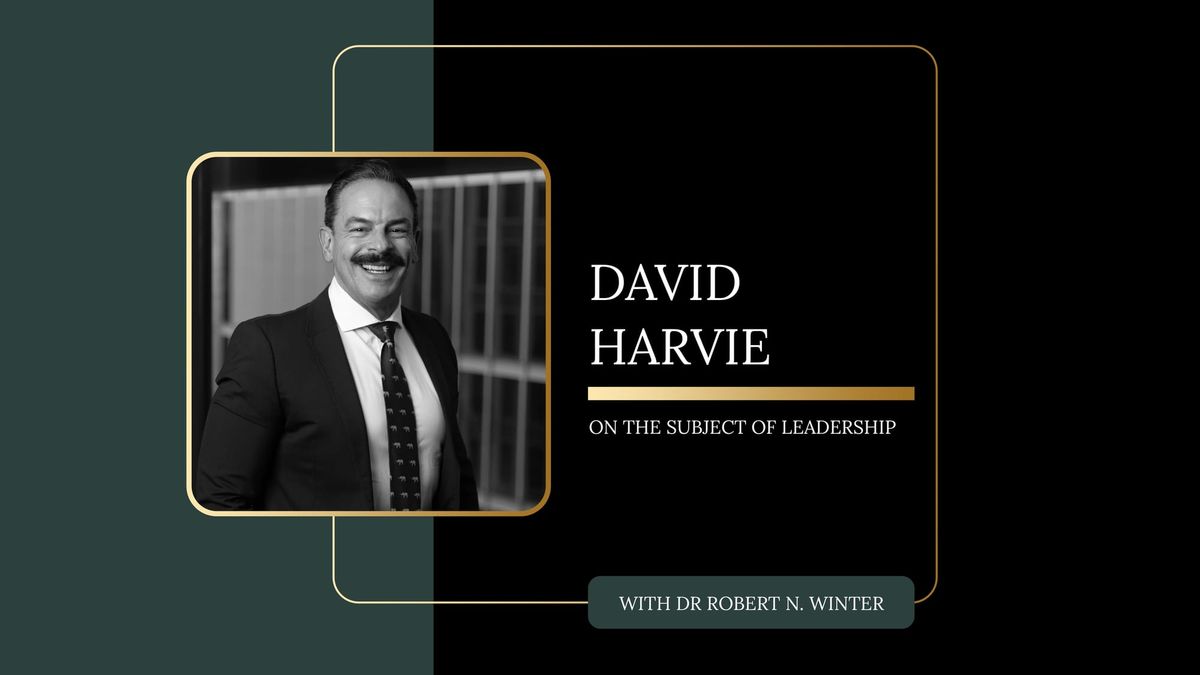
My guest this week is David Harvie, who after close to three decades in Australian financial services is now Director, Wholesale Distribution @ Ausiex.. Alongside that he has built DadBodz, a health venture aimed at time-poor fathers, and has since co-founded NEXUS Holistic Health. He and I studied leadership together as postgraduates, in an MBA seminar room where the philosophies were handed to us as objects of contemplation rather than instruments. He is one of the few people I could ask which of them survived.
What follows are the ideas from the conversation I have continued to turn over since.
Chevrons on the Shoulder
David grew up in far north-western New South Wales, the son of a bank manager, in a town where authority was distributed among a handful of visible men and one formidable headmistress: the sergeant, the publicans, the farmers, the president of the bowling club. He describes the primary school headmaster as a man who ruled with an iron fist and very little logic, his authority resting on the metaphorical chevrons on his shoulder and nothing else. What irked him as a child was not the severity. It was the absence of reasoning.
He reached for the German when he described it, and the reach was apt. Max Weber (1864–1920) defined Macht as the probability that an actor will carry out their own will despite resistance, regardless of what that probability rests upon, and Herrschaft as the probability that a command of given content will be obeyed by a given group. The distinction is not the flattering one usually assumed. Herrschaft is not a nobler species of power; it is the narrower fact of commands being obeyed—and the headmaster plainly had it. What Weber adds next is load-bearing. Material interest and habit make an unstable basis for obedience, so every system of authority attempts to cultivate a belief in its own legitimacy, resting on rational grounds: legal, traditional or charismatic.
David's claim is that the young people he now leads require the reasoning more than any cohort before them. It is the sort of generational assertion that ought to be received sceptically, and I know of no evidence establishing that this cohort differs in kind. But the underlying observation is sturdier than the generational framing, and it is Weber's: authority that cannot account for itself is spending down a balance it did not earn.
The System that Worked
The strongest passage in the conversation concerns Merrill Lynch in Sydney in the late 1990s. David describes a physical and symbolic architecture of quite remarkable coherence. The intake sat on the outer ring of a concentric floor plan and moved inward as they succeeded. Salespeople progressed through a hierarchy of birds—swallow, cormorant, egret, eagle—toward the falcon, and the Falcon's Club was both a metaphor and a room. Individual numbers were posted twice daily, visible to the person and to everyone else. He does not disown any of it. His verdict is unambiguous: "it worked. It really, really worked."
Michael Burawoy (1947–2025) spent a year as a machine operator on a Chicago shop floor asking why workers were producing so much for so little, and concluded in Manufacturing Consent that the answer was the game. Where effort is organised as a contest with visible standings, participants consent to their own exhaustion, because the game is genuinely absorbing and because winning it is genuinely satisfying. Burawoy's argument was not that the workers were duped; it was that consent is manufactured most effectively when it is freely given, and that playing the game is simultaneously the act of accepting its rules. The methodological caveat should be stated plainly: this is a single participant-observation study of one American factory in the 1970s, making no claim to statistical generalisation. It offers a mechanism, not a measurement.
What is striking is how precisely David's account of the pull matches that mechanism. He describes the symbolism of the firm as almost irresistible to a young man, and the movement inward as both metaphor and floor plan; he wanted not merely to reach the centre but to be at the centre. None of that is the language of coercion. It is the language of a game one very much wants to win. He also noticed something adjacent: for all the marble and the tailoring, he says, there was a lack of base—no foundation underneath the performance. He did not have the vocabulary at the time. But he did have the discomfort.
David reached the top tier. He was flown to New York. And then, at a point he could not predict, the wiring gave out—he could not get out of bed, could not face anything. He says it took him years to understand what it had cost. Both halves of that account are true simultaneously, and he does not resolve them. Neither, I think, should he. The uncomfortable implication is that the features which made the system effective for the organisation are the ones that made it costly for the people. Visibility motivates because it exposes. Progression motivates because exclusion is real. Remove the sting and you have removed the mechanism.
What the Watching Eye Learns
The recovery, as he tells it, began with becoming coachable—surrendering, in his phrase, and conceding that his father, the sergeant and the headmistress of his small country town school may have been right about him after all. What he found on the other side was that he was a good coach himself, and his account of what coaching consists of is unusually direct: he says he loves the people he leads, and that loving them sometimes means promoting them, sometimes having a hard conversation, and sometimes telling them to leave.
He then makes a claim that carries more weight than its casual delivery suggests. The small disciplines—the made bed, the cold shower, the breathing—are not private. Employees see the actions. So do children. Albert Bandura (1925–2021) established that a very great deal of human behaviour is acquired by observing another person perform it and noting what follows, mediated by attention, retention, reproduction and motivation rather than by direct reinforcement alone. He argued separately that vicarious experience—watching someone comparable succeed—is one of four principal sources from which expectations of personal efficacy derive. The mechanism does not care whether the model intended to teach.
This is the uncomfortable half of Bandura's work that a lot of leadership writing leaves out: modelling is not a technique a leader deploys, it is a condition a leader is in. David draws the consequence warmly, in terms of a child seeing a father present regardless. The other direction follows just as surely. If the small consistencies register, so does the impatience, the shortcut, the standard quietly dropped when nobody was thought to be watching. The circulating version of this idea is almost always the encouraging half, in which a leader models excellence and a team absorbs it. The full version is less convenient. A leader is a permanent broadcast with no editorial control over which parts are received.
Standards Written by the Governed
The most instructive story he tells is about a football team of five-year-olds. Rather than issue the boys a code, he asked them what they wanted to stand for. They produced three pillars: they would have fun; they would win—including at training and at particular skills, so that a lost match could still contain a victory; and, at the suggestion of a quiet boy, everyone would put in and hold standards. Those pillars survived six or seven years and a substantial turnover of players.
Then the better players were selected into a development squad with no such pillars, and after six months his son asked to be driven home and said he wanted to stop. He reasoned it out: the new environment did not meet the standards he had helped write at five.
Elinor Ostrom (1933–2012) spent a career establishing what that story illustrates. Examining long-enduring institutions governing irrigation systems, alpine pastures and inshore fisheries, she identified design principles common to those that survived across generations—among them that most individuals affected by the operational rules participate in modifying them, and that monitoring and graduated sanctions are undertaken by the appropriators themselves rather than imposed from outside. Her method was a structured comparison of documented cases selected in part because they endured, framed as a corrective to prevailing models rather than a test of them. The finding travels nonetheless: rules handed down from outside decay; rules authored from inside are defended. David repeated the move a quarter of a century later with his health company co-founders, agreeing rules of engagement and deadlock procedures aloud before there was anything to fight about—which is the only moment at which such an agreement can honestly be made.
The Queue
His father, a man of few words, had a saying about where fathers sit in the order of things: at the very back. David recites the queue—children first, children second, immediate family, school, sport, shopping, mortgage, bills, weddings, funerals—and is careful to say that the same could be said of mothers, who are frequently the sole carers and who often surrender career time to it.
He is right to be careful, and the careful version is the better-evidenced one. Arlie Russell Hochschild (b. 1940) and Anne Machung interviewed dual-career American couples with young children through the 1980s and found the domestic and caring work falling disproportionately to women, including in couples who sincerely believed they were sharing it equally. The study is qualitative and its fieldwork is now four decades old; the point to take from it is the asymmetry, not a current Australian figure. David's observation survives Hochschild's: the queue is real for both parents, and it is longer for one of them.
What he does with the observation is where I part company with the easy reading. He refuses to treat it as a constraint. It has nothing to do with time, he says. Zero. It has everything to do with priority. He rises at four; the cold shower, the breathing and the writing happen before five. And he states the premise plainly: to be the best father he can be, it has to start with him.
That is a stronger claim than it looks, and it is not obviously available to everyone who might hear it. A four o'clock start can be a priority for a man whose children are teenagers. It is a different proposition for the parent of an infant, the shift worker, or the sole carer Hochschild describes. David would, I think, accept this; the claim is offered as his own practice rather than as a prescription. But the line travels well and the qualification does not, which is the ordinary fate of a good line.
Judgement is the Context
Which brings me to the moment in the lightning round I have thought about most.
Asked to choose between discipline and judgement as the single capacity to develop in a young leader, David's first answer was judgement. He then noticed himself preparing to say discipline instead, because discipline was what he had spent the hour describing, and declined the substitution. Discipline, he decided aloud, is a mechanism—a framework, a physical function. Judgement is the context in which all of it happens.
It was not the only time he declined to be consistent. Asked for the most overrated word in leadership, he answered without hesitation: alignment. This sits oddly beside his earlier argument that diversity of background and perspective produces better decisions, and that executing a plan does, paradoxically, require alignment at some point. He flagged the paradox himself and left it standing. I think he is right to. Alignment is overrated as a virtue and indispensable as a phase, and the error is treating a thing needed at the end of a process as the thing to optimise for at the beginning.
He has spent an hour building an elaborate architecture of self-command and, invited to name its foundation, has named something else. I do not think this is a contradiction so much as a correction, and it is the most valuable thing he says. A person can be extremely disciplined at the wrong thing and be surprised by the outcome. The Merrill Lynch machine was not short of discipline. Everyone in the concentric rings was disciplined. What it lacked was any mechanism for asking whether the game was worth playing at that price—and that is not answerable by more discipline. It is a judgement call.
Which returns us to the opening question, and to my one real reservation. David now leads a sales team where performance is visible and measured. He defends that visibility, and defends it well: it does not serve a salesperson to be ignorant of where they stand. He is describing a gentler version of the machine that broke him: the numbers without the birds, the standings with the coaching. I believe him that the difference is real. I also note that it rests on his own intent and judgement, and that the Falcon's Club managers would very likely have described their intentions in similar terms. The safeguard is not structural. It is a person's character, which is to say it is exactly as durable as they are.
David would probably accept that too. He is, after all, the one who said judgement is the context.
Good night, and good luck.