

There is a peculiar superstition abroad in the LLM age: that good punctuation—particularly the em-dash—is suspicious. If a sentence carries itself with a certain poise, if clauses are balanced with grace, if the em-dash appears as anything other than a hacked-in hyphen, some will mutter that the text "looks like AI." It is an irony Wilde might have enjoyed. The very marks once associated with precision, wit, and literary control have become, in some quarters, evidence of mechanisation.
Yet the idea collapses under the slightest historical pressure. The great English stylists of the last two centuries deployed the em-dash with abandon. They used it not as ornament but as an instrument: a hinge, a turn, a breath, a point of emphasis. Long before algorithms arrived, writers were using punctuation with a sophistication now deemed artificial.
The problem, I suspect, is not the em-dash itself but our cultural anxiety around authorship. In an age when text can be conjured instantly, people have grown skittish, scanning prose for cryptic signs of machine influence. What they rarely scan is the literary canon. If they did, they would discover that the em-dash is as human as any other punctuation mark on the page.
There is a useful parallel to be drawn between the contemporary decline in linguistic standards at work and the collapse of sartorial elegance in the office—for those who still attend. Since Covid, the hoodie and yoga pants have migrated from weekend anonymity or casual Friday fun when working from home, to weekday orthodoxy. Anything approaching a collar and tie—or a tailored pant suit—is treated with faint embarrassment, as though effort itself were a kind of moral failing. The same suspicion now attaches to language. Clipped sentences littered with errors signal authenticity; compound sentences suggest artifice. Brevity is praised as clarity; structure is misread as pretension. Just as formal dress is caricatured as inauthentic performance rather than professional courtesy, so too is carefully constructed prose dismissed as unnatural, or worse, automated. In both cases, what is really being rejected is not excess but discipline—the visible signs that someone has taken the trouble to meet a standard rather than retreat from one.
A Lineage of the Dash
Take Emily Dickinson (1830–1886), who elevated the em-dash almost to metaphysics:
Mr Higginson,
Are you too deeply occupied to say if my Verse is alive?
The Mind is so near itself—it cannot see, distinctly—and I have none to ask—
Should you think it breathed—and had you the leisure to tell me, I should feel quick gratitude—
If I make the mistake—that you dared to tell me—would give me sincerer honor—toward you—
I enclose my name—asking you, if you please—Sir—to tell me what is true?
That you will not betray me—it is needless to ask—since Honor is it's own pawn—
— Is "my Verse ... alive?", 1862)
Her dashes breathe. They fracture the line in a way commas never could. To accuse such punctuation of artificiality would be to misunderstand not only Dickinson but language itself.
Henry James (1843–1916), for all his labyrinthine sentences, relied on the em-dash when he wished to deliver a decisive turn:
Under certain circumstances there are few hours in life more agreeable than the hour dedicated to the ceremony known as afternoon tea. There are circumstances in which, whether you partake of the tea or not,—some people of course never do,—the situation is in itself delightful.
— The Portrait of a Lady, ch. 1
This passage—characteristically Jamesian—uses the em-dash not for emphasis but for social calibration. The sentence begins as a measured generalisation, but the dash introduces a wry aside ('some people of course never do') that shifts the register from abstract reflection to keen social awareness. The aside is not logically necessary, but it is tonally essential. The em-dash slows the sentence more than a comma would, allowing the narrator to acknowledge exception, eccentricity, and choice without derailing the thought. It gives the observation just enough prominence to humanise the claim: the pleasure lies not in tea as a beverage but in tea as a social situation. The punctuation enacts the ethic of the sentence—civilised, inclusive, lightly ironic—and demonstrates precisely why the em-dash remains a mark of human judgment rather than mechanical habit.
Or consider F. Scott Fitzgerald (1896–1940), whose prose was sculpted more finely than his reputation sometimes suggests:
He smiled understandingly—much more than understandingly. It was one of those rare smiles with a quality of eternal reassurance in it, that you may come across four or five times in life. It faced—or seemed to face—the whole eternal world for an instant, and then concentrated on you with an irresistible prejudice in your favour. It understood you just so far as you wanted to be understood, believed in you as you would like to believe in yourself, and assured you that it had precisely the impression of you that, at your best, you hoped to convey.
— The Great Gatsby, ch. 3
Fitzgerald knew the value of pause and acceleration. The dash propels the reader through a shift of tone—a movement accessible only through that mark.
Virginia Woolf (1882–1941) used the em-dash to reveal interiority, capturing the ebb and flow of consciousness:
"Do you write many letters, Mr. Tansley?" asked Mrs. Ramsay, pitying him too, Lily supposed; for that was true of Mrs. Ramsay—she pitied men always as if they lacked something—women never, as if they had something.
— To the Lighthouse, ch. 17
And George Orwell (1903–1950)—patron saint of plain writing—was no stranger to the em-dash either. He used it sparingly, but when he reached for it, he reached with purpose:
Probably it is better to put off using words as long as possible and get one's meanings as clear as one can through pictures and sensations. Afterward one can choose—not simply accept—the phrases that will best cover the meaning, and then switch round and decide what impression one's words are likely to make on another person.
— Politics and the English Language
Those who claim the em-dash is too neat or too structured or too mechanical to be human would need to indict these writers as proto-algorithms. An absurd notion up with which I shall not put!
My Years in Trade Publishing: the Editors Who Waged War on the Dash
I spent years in trade publishing watching editors argue—sometimes passionately, always pedantically—about punctuation. The em-dash, curiously, was rarely their enemy. Their scorn was directed at the hyphen masquerading as one: that stunted mark jammed between words by authors who either didn't know the difference or didn't care.
Editors hated that. They hated it the way a violinist hates a flat note. "If you mean an em-dash," one senior editor would say, "have the courage to use one." Another kept a Post-it on her monitor: '-' ≠ '—'. Almost Biblical in its clarity.
But the genuine em-dash? That was a sign of craft. A sign the writer understood how clauses interact. A sign the rhythm of the sentence had been heard, not merely assembled. Editors respected the em-dash because it marked intention.
Which is why today's suspicion feels misplaced. If you want to sound clever in the old-fashioned editorial sense, criticise the misuse of the dash—not its proper deployment. The editors of my career took no issue with the em-dash. Their quarrel was with sloppiness.
A Culture that Fears Signs of Competence
Why, then, the contemporary aversion? Because the digital era has produced a strange reversal: competence itself has grown suspect. When so many poorly punctuated messages flood the world daily the appearance of control, of structural awareness, seems uncanny.
The idea that a tool's elegance signals artificiality is a confusion of categories. We do not look at a well-built stone wall and assume it must have been constructed by a robot. We attribute quality to craft, not to circuitry. Yet somehow the act of writing has been recast as suspicious precisely when it is executed well.
The em-dash, caught in this new superstition, becomes collateral damage. But it is not the mark that has changed; it is our imagination.
What the Em-dash Actually Does
For those of you who viewed the em-dash with a wary eye, but having made it this far are now wary of misplaced ire, what function does this inestimable punctuation mark serve? It has several functions, all of them legitimate and none replaceable without cost.
Most commonly, it operates as a lighter, more permeable alternative to parentheses. Parentheses quarantine a thought; they signal that what follows is optional, secondary, or best skimmed. The em-dash, by contrast, insists that the inserted material be read. It allows a sentence to momentarily widen its field of vision without relinquishing control of its argument. The effect is not apologetic but conversational: the sentence pauses, turns, and resumes with greater texture intact. Compare:
- The meeting—which should have ended an hour ago—continued interminably.
- The meeting (which should have ended an hour ago) continued interminably.
The first is alive; the second, apologetic.
The em-dash also marks interruption and tonal shift—those moments when thought revises itself mid-stride. Dickens used it not to decorate but to dramatise cognition, allowing a sentence to register jealousy, irony, or reconsideration as it unfolds rather than after the fact. In this sense, the dash captures thinking in motion, not thinking already resolved. As Dickens demonstrates in David Copperfield:
Grey as he was—and a great-grandfather into the bargain, for he said so—I was madly jealous of him.
Third, the em-dash restores clarity where commas begin to collapse under strain. Complex sentences often require hierarchy, not mere separation. When too many ideas are forced through commas alone, the reader is left to infer structure rather than follow it. The em-dash reasserts that structure cleanly, signalling emphasis without resorting to blunt devices such as exclamation or fragmentation.
Fourth, is the em-dash's ability to signal omission. Where words are deliberately left unsaid—whether through tact, restraint, or rhetorical compression—the dash acknowledges absence without spelling it out. It allows the sentence to gesture rather than enumerate, trusting the reader to complete the thought. This economy is not evasive; it is respectful, and it avoids the false precision that often weakens prose.
Mr. Tulkinghorn takes out his papers, asks permission to place them on a golden talisman of a table at my Lady's elbow, puts on his spectacles, and begins to read by the light of a shaded lamp.
"'In Chancery. Between John Jarndyce—'"
My Lady interrupts, requesting him to miss as many of the formal horrors as he can.
— Bleak House, ch. 2.
Finally, the em-dash mirrors the rhythm of actual reasoning. Human thought is rarely linear; it detours, qualifies, and recalibrates. The em-dash accommodates this without breaking the sentence apart. It is, in effect, a typographical breath—longer than a comma, less final than a full stop—allowing nuance to surface without derailing momentum.
This is why serious writers relied upon it. Not because they lacked discipline, but because they possessed it. The em-dash exists not to weaken prose, but to prevent it from lying about how thought really moves.
The Fear of Resemblance
What unsettles critics, I think, is that AI systems also use em-dashes. This is not because the em-dash is inherently mechanical, but because AI was trained on human literature. The dash appears in machine-generated text because it appears in human-generated text—centuries of it.
To reject the em-dash on this basis would be to reject any construction AI can replicate. Goodbye to the semicolon, so beloved of Woolf and Eliot. Farewell to the colon that Wodehouse used it to magnificent comic effect. Adieu to the compound sentence, without which James would be unpublishable.
One might as well ban the alphabet.
This is not to say all uses of the em-dash are good. Like any tool, it must be handled judiciously. Too many dashes can make prose breathless, nervy. Too few, and sentences stiffen.
The point is not to use the em-dash universally but to use it intentionally. Punctuation is, in a sense, a moral art. It signals the writer's care for the reader's comprehension. A thought properly set out is an act of respect.
AI, by contrast, has no such moral stake. It does not care whether a clause lands or whether a rhythm works. It produces patterns. Humans produce meaning. The em-dash belongs to the latter domain.
What We Should Criticise
If one truly wishes to distinguish human writing from machine writing, the place to look is not punctuation but insight—judgment, experience, moral intuition. A machine can place an em-dash, but it cannot intend one.
Criticising punctuation is the literary equivalent of tapping the bodywork of a car and pronouncing upon the quality of its engine. One must look deeper.
But if one insists on waging war over punctuation, then at least wage the right war. Attack the wrong dash—the hyphen used in place of the em-dash. Attack laziness, muddle, and the half-thought. But do not attack the em-dash itself. It has done nothing but serve language faithfully.
Perhaps we might even rehabilitate the em-dash. Celebrate it. Use it with confidence, knowing we stand in a lineage that includes Dickens, James, Fitzgerald, and Orwell—not the worst company a writer could keep.
To write well is to choose well. And sometimes the best choice is the em-dash.
After all, as E. M. Forster once wrote in a moment of syntactical epiphany:
How can I tell what I think till I see what I say?
The em-dash has always been part of that seeing. It deserves our defence, not our doubt, much less our defamation.
Good night, and good luck.
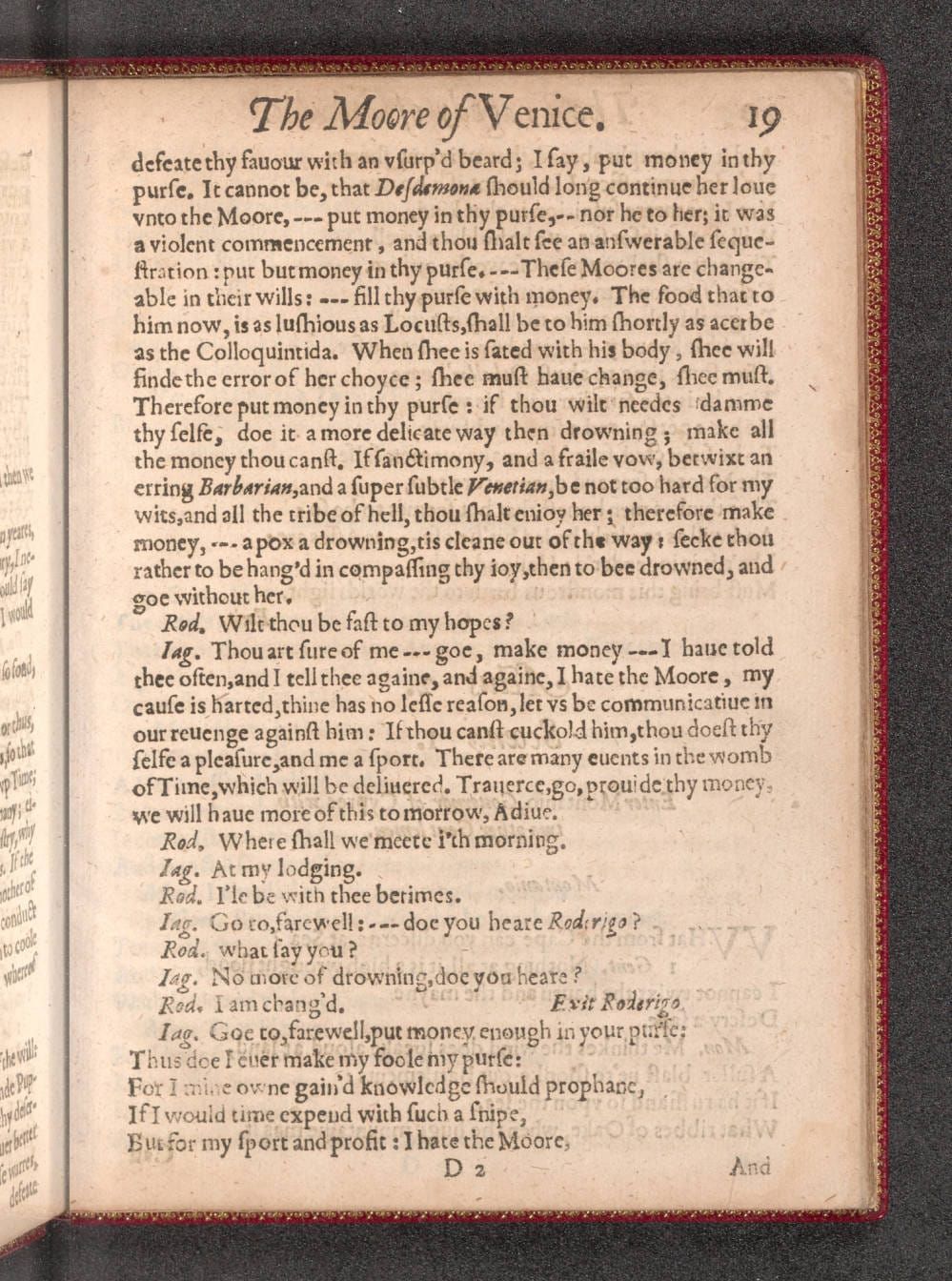
Tragedy of Othello, 1622 Oakes print, page 19 is licensed under Public Domain.
Member discussion
The discussion is open to members of the Commons. Join, free, or sign in to take part.