
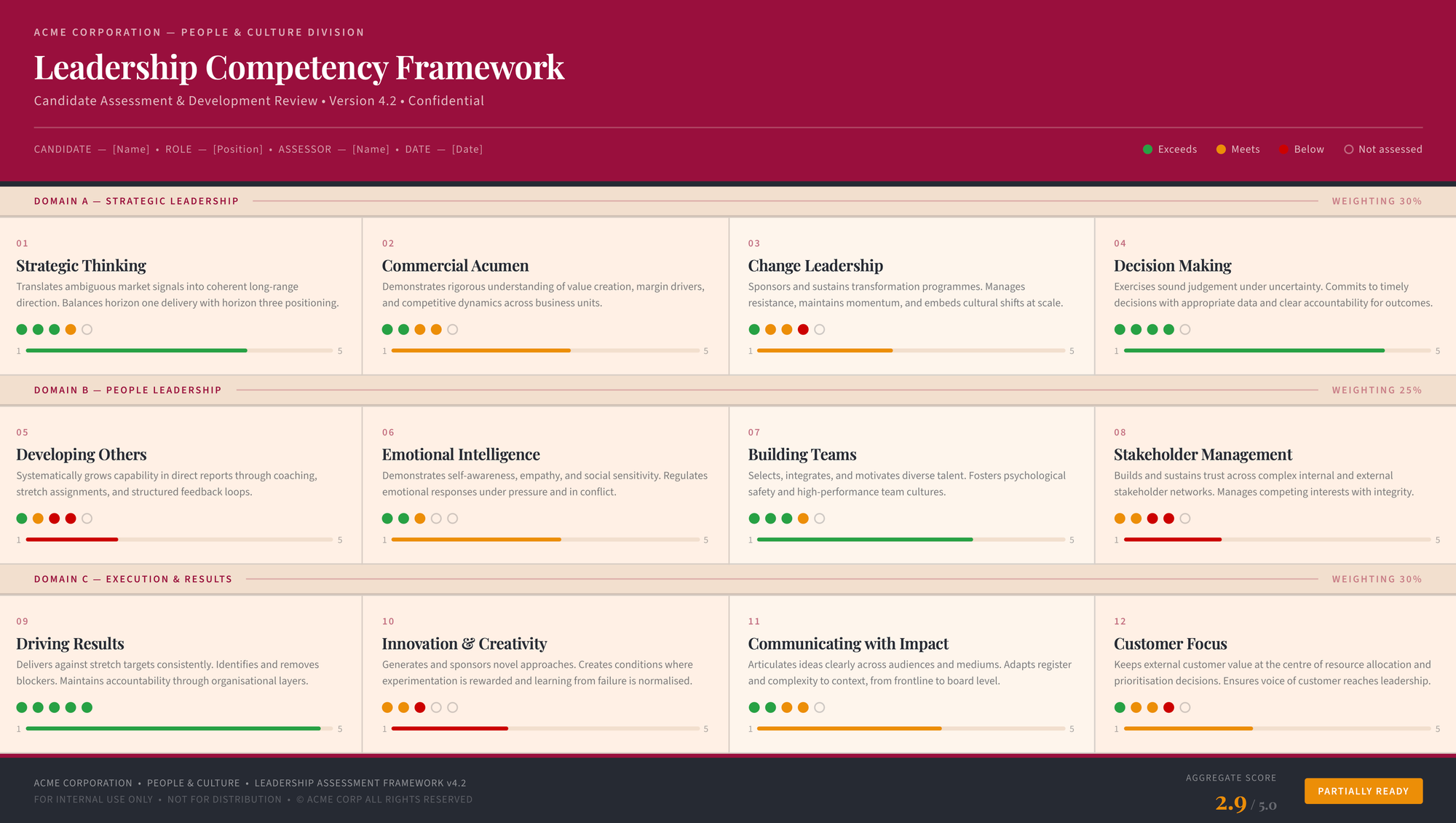
Somewhere in every large organisation there is a laminated poster setting out the firm's leadership competency framework. Twelve boxes, sometimes sixteen, occasionally twenty, listing things like: Strategic Thinking; Driving Results; Developing Others; Emotional Intelligence; Change Leadership. The language varies between consultancies and which Org Behaviour magazine HR departments read, but the grammar is constant—a finite grid of capabilities, each amenable to rating, training, and aggregation into a score. New hires are assessed against it. Middle managers are developed against it. Potential successors are filtered through it. Entire careers are built, or broken, on the distribution of green dots and red dots across these little boxes.
The frameworks are so ubiquitous, and so obviously sensible at first glance, that the question of whether they describe anything real is rarely asked in boardrooms. It is asked, quietly and persistently, by researchers and practitioners who have spent enough time near actual leadership to notice that the people who do it well are seldom distinguished from the people who do it badly by anything that appears on the grid. A chief executive of genuine quality will in all probability tick the same boxes as the charlatan who replaces her. The grid does not see what matters. This is because it was never designed to.
What the Framework Misses
The thing the grid cannot see was named by Aristotle two and a half millennia ago, and the fact that the term has not made it into most HR dictionaries is itself worth a moment of reflection. Phronesis—practical wisdom—is the intellectual virtue by which a person of experience perceives the relevant features of a particular situation and decides how to act well in it. In the sixth book of the Nicomachean Ethics, Aristotle is careful to distinguish it from two neighbouring capacities that competency frameworks routinely confuse it with. It is not techne, the technical skill by which one makes things according to rules. It is not episteme, the theoretical knowledge of universals that can be taught from a textbook. It is the capacity to see, in the particular case, what this person needs from you now, what this board will bear, what this decision requires that the last superficially similar decision did not.
The distinction matters because techne and episteme readily lend themselves to being decomposed into lists. You can specify the rules of double-entry bookkeeping. You can examine a candidate on the theorems of microeconomics. Practical wisdom however resists this treatment. The moment it is reduced to a checklist it ceases to be wisdom and becomes a rule—and rules, applied without judgment to cases they were not designed to fit, produce precisely the kinds of decisions that organisations later commission consultants to investigate. The manager who has learned the rule that "good leaders communicate openly" and then communicates openly when the situation calls for discretion, will likely be bewildered when the board reacts badly. A manager of deep experience will know that while the rule was correctly followed—judgment was absent.
What distinguishes the leader who survives a genuinely difficult decade from one who does not is not a thicker file of competency ratings but something closer to what a good clinician possesses by the twentieth year of practice—a stock of pattern recognition built from cases seen, misjudged, and reconsidered, refined by the kind of reflection that competency training neither requires nor rewards. This stock is neither trainable nor transferable in any straightforward sense. It is acquired slowly, in context, by people who are paying the right kind of attention to the right kinds of things. And it is the entire substance of what organisations mean, in their more honest moments, when they say they want better leaders.
Where the Grid Came From
It is worth returning to the intellectual origins of the competency framework, because the story is less disreputable than the current practice makes it look. David McClelland's 1973 paper arguing that organisations should test for competence rather than for intelligence was, in its context, a sensible corrective. The intelligence-testing industry of the time was producing confident predictions about management potential that tracked socioeconomic background more reliably than they tracked management performance. McClelland's proposal—that we should look at what successful performers actually did, rather than at what they scored on abstract tests—was reasonable and empirically minded. Whatever one now thinks of the consequences, the original move was a good one.



Member discussion