Most conversations about artificial intelligence and the executive begin with a number that refuses to move. For the better part of a decade the surveys have promised imminent transformation; for the same decade the measured return has stayed obstinately flat, and the proportion of firms capturing any material earnings impact is lower today than it was in 2019. The convenient inference is that the technology has been oversold. My guest this week draws a more demanding one.
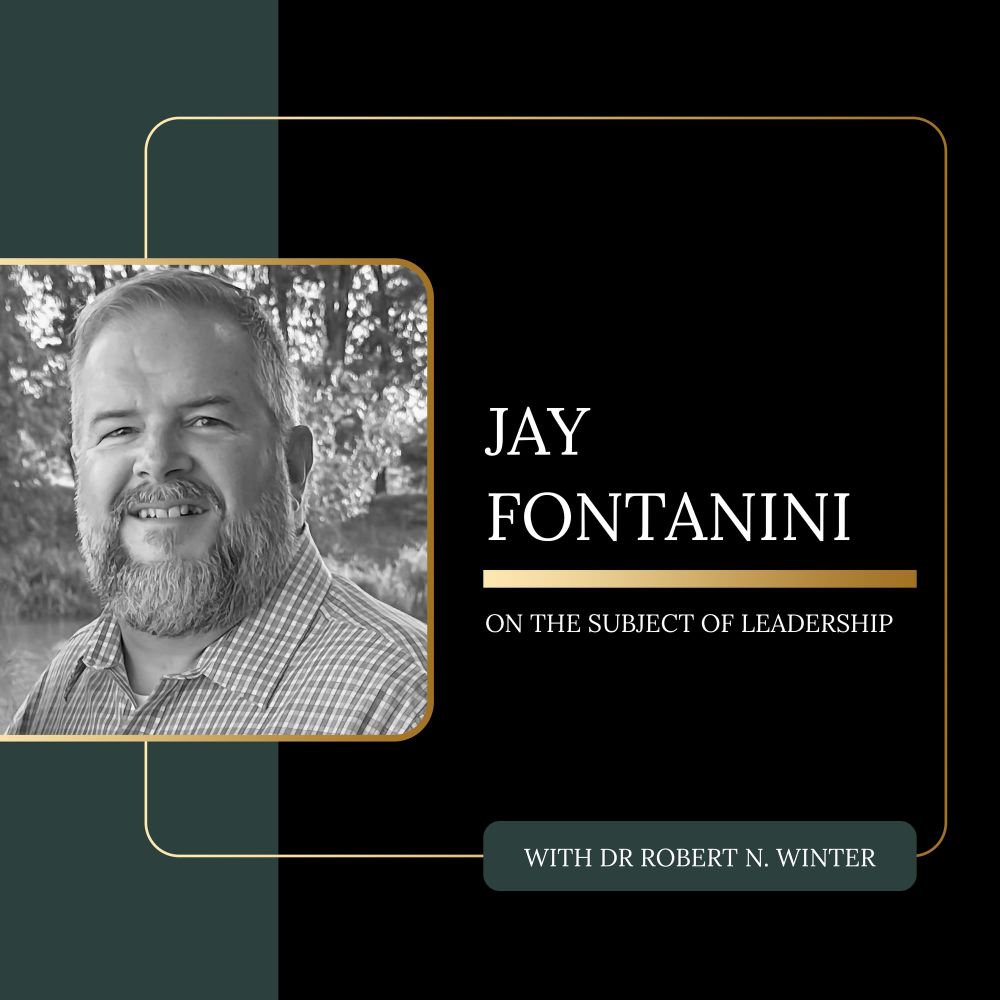
In this episode of On the Subject of Leadership, I speak with Jay Fontanini—an operator of three decades in property and casualty insurance, latterly the builder of an executive accelerator, and, by his own cheerful confession, a liberal-arts theologian who earns his living in analytics. His case is that the flat number is not a verdict but a phase: the characteristic signature of a general-purpose technology whose complementary investment has not yet been made. The complement that matters most, he argues, is not more capable software. It is human capital—and, at the centre of that, judgement.
What follows are the ideas from that conversation I have continued to turn over since.
The Shape of a General-Purpose Technology
The flat number is not new, and neither is the shape of the argument Jay uses to explain it. Robert Solow (1924–2023) delivered the canonical version of the puzzle in a book review, remarking that the computer age was visible everywhere except in the productivity statistics. The resolution came three years later from the economic historian Paul A. David (1935–2023), whose essay on the dynamo and the computer observed that electrification had delivered almost no measurable productivity gain for some four decades—not because the technology was weak, but because the gain waited on a reorganisation no one had yet performed. Factories built around a central steam engine and its line shafts had first to be rebuilt around distributed electric motors before the new source of power paid for itself. The dynamo was ready long before the factory was.
This is the family of technologies that Bresnahan and Trajtenberg named: the general-purpose technology, characterised by 'pervasiveness, an inherent potential for continued technical improvement, and what they term 'innovational complementarities''—the property that innovation in the general-purpose technology raises the productivity of research and development in the sectors downstream of it. Its returns arrive late and unevenly because those complements must be invented before the engine in the middle can do any real work; and because the relationship between the technology and its users is mediated by arm's-length markets, the authors argue, a decentralised economy tends to under-invest in exactly the complementary innovation on which the returns depend.
The most rigorous contemporary statement of the pattern is the productivity J-curve of Brynjolfsson, Rock and Syverson. General-purpose technologies, they argue, demand large intangible investments—business-process redesign, new business models, and, tellingly, human capital—which the national accounts measure poorly or not at all. In the early years the spending is visible and the payoff is not, so productivity growth is understated; later, as the intangible assets are harvested, it is overstated. Adjusting the United States figures for intangibles associated with computer hardware and software, they find a level of total factor productivity 15.9 per cent higher by the end of 2017 than the official measures record.
Jay's reading of the present sits squarely inside this tradition, and it is the strongest available account of the flat number. It is worth saying plainly, though, where its danger lies—a point I pressed in the conversation and will press again here. A theory that explains an absent return as unfinished co-invention is powerful precisely because it can absorb almost any delay: flat at year nine and it is early, flat at year nineteen and it is merely later. What keeps the J-curve honest is that the intangible investment it posits is a real thing and not a rhetorical one. The test is whether the complementary work is actually being done—whether an organisation can point to the redesigned process and the retrained person—or whether "we are still on the curve" has quietly become the thing one says instead of making the organisational changes.
The symmetry worth holding onto is that the same claim operates at two scales. An economy cannot skip the J-curve; a person, as Jay puts it, cannot skip the stages. In both cases what is absent is the complementary investment, and in both cases the temptation is identical—to declare the payoff imminent rather than perform the work that produces it.
The Complement Is Judgement
If the binding constraint is a missing complement, the obvious question is which one. Jay's answer, and the book he would press on anyone before they touch a keyboard, is Prediction Machines by Ajay Agrawal. Its framing is elegantly economic. What artificial intelligence does cheaply is prediction—the filling-in of missing information—and a first principle of economics is that when the price of something falls, the value of its complements rises. As machine prediction becomes abundant and nearly free, the scarce and therefore valuable good is the thing prediction cannot supply: the judgement to determine what is worth predicting, and what to do once the prediction is in hand.
Jay gives this abstraction a human physiology by borrowing a distinction Raymond Cattell (1905–1998) established experimentally, and which Arthur Brooks has lately made fashionable: between fluid intelligence, the quick reasoning and rapid recall that peak early and then decline, and crystallised intelligence, the accumulated knowledge and seasoned judgement that rise across a working life and hold steady. The models, Jay suggests, are a near-perfect substitute for fluid intelligence—they recall, they organise, they reason at speed—which is exactly why they throw the whole of the human premium onto the crystallised kind. The machine is cheapest where we were quickest, and no help at all where we were wise—if a little slow. It is a rare thing to watch an operator arrive, by way of a personal-training analogy and a book about ageing, at the same place as the frontier of the economics.
Earned, Not Learned
Pressed on whether judgement of this kind can be taught, Jay balked at the verb. Judgement, he said, is not learned but earned—cumulative, progressive, the residue of experience laid down over time. It is why he worries less about his own generation than about the young, who may never be made to sit with a difficult problem long enough for judgement to form, because an easy answer is always to hand.
He is in old and good company. Aristotle (384–322 BC) drew the line precisely in the sixth book of the Nicomachean Ethics, between the knowledge that can be transmitted by instruction (techne) and phronesis, the practical wisdom that governs action in particular circumstances. The young, he observed, may become accomplished in geometry and mathematics, which can be learned from propositions, and yet not become practically wise—for practical wisdom is concerned with particulars, and particulars are known through experience, which the young have not had the time to acquire. Two and a half thousand years later the neuroscience has merely supplied a mechanism for the observation. The point survives its restatement: some things cannot be hurried, and the attempt to hurry them produces the confident appearance of a wisdom that is not there. If Jay is right that the machine now supplies the transmissible part cheaply, then the untransmissible part—the earned part—becomes very nearly the whole of what distinguishes one human from another.
Where They Stop Is the Dialectic
The pedagogy Jay has leveraged to cultivate that part is, improbably, the medieval trivium: grammar, dialectic, rhetoric, in that order and without shortcuts. Grammar is orientation, the rules of the new language; dialectic is the working with it, thinking in genuine exchange; rhetoric is deploying the result with, and upon, other people. Asked in the lightning round where his executives quietly give up, his answer was immediate and, I think, important. Not at grammar, which they will tolerate. They abandon at the dialectic—the middle, effortful stage—and try to leap straight to rhetoric, holding forth about a tool they have not learned to think with. It is why the market for "the ten best prompts" is inexhaustible, and why so little true value comes of it.
There is a precise philosophical name for what is being skipped. Gilbert Ryle (1900–1976) distinguished knowing-that from knowing-how, and warned against what he called the intellectualist legend: the assumption that intelligent performance is merely the application of some prior set of propositions, considered and then executed, The executive who wants the perfect prompt is seeking knowing-that—a rule to be handed over and applied. The dialectic asks instead for knowing-how, which is not reducible to a rule and cannot be transferred by being told; it is acquired only in the doing. Michael Polanyi (1891–1976) fixed the same limit memorably: we can know more than we can tell. The tacit ground of good judgement will not compress into a prompt library, however long, because the most important part of it was never propositional to begin with. This, and not any shortage of clever templates, is why the middle stage cannot be skipped.
The Case for Friction
The instinct beneath all of this is one Jay names directly, and it is the one I find most congenial: intentional human friction. He keeps an assistant system with a rich context of his affairs that can draft almost any reply; it is permitted to draft everything and to send nothing. The friction is deliberate, inserted at exactly the points where the stakes are high and a plausible error would be costly. It is a small, disciplined refusal of the thing the technology most wishes to give us, which is ease.
Ease is worth being suspicious of, because the evidence that it carries a cognitive cost is now more than anecdotal. The human-factors literature has long documented automation bias and automation complacency—the tendency to over-trust an automated aid and to cease monitoring it, most pronounced under multiple-task load, and found in expert and novice operators alike rather than being cured by practice or instruction. Nearer the present worry, Risko and Gilbert describe cognitive offloading—the use of physical action to reduce the information-processing demands of a task—as an ordinary and often useful human habit, but one that reshapes what we retain and can later do unaided. And a study by Gerlich, surveying 666 participants, reports a significant negative association between frequent use of AI tools and critical-thinking scores, with cognitive offloading as the mediating factor and younger participants showing both the heaviest reliance and the lowest scores. It is a correlational, self-reported, single-author study and as such should be viewed with a wary eye—but it points the same way as the older work, and the same way as Jay's unease.
The right response is not abstention but design. In an earlier piece I argued that the ambition should be an extended mind rather than an outsourced one—the phrase is Clark and Chalmers'—and that the difference between the two is endorsement: the tool genuinely extends your cognition only if you understand it, interrogate it, and remain able to tell when it has gone wrong. Friction is how endorsement is kept alive. It is the mechanism by which a person stays in a position to exercise the very judgement the whole argument has been about. Jay reading Superintelligence: Paths, Dangers, Strategies by Nick Bostrom slowly, pen in hand, is not nostalgia; it is the same principle applied to his own mind.
Language at the Centre
There is a pleasing irony that Jay, the theologian among the analysts, is unusually placed to see. The engineers built a large language model, and put language at the centre of it. The instrument now mediating a great deal of executive work is, at bottom, a device for handling meaning—and meaning is the native territory of the humanities, not of engineering. Much of what goes wrong in organisations adopting these tools is not technical at all but linguistic: the quiet equivocation in a shared term, the acronym that saves three seconds at the cost of a 30 minute follow up meeting, the report whose author cannot say plainly what it is for. Communication, as I regularly say, begins not at the speaker's mouth but at the listener's ear.
This is also the strongest case for the diverse team, and Jay makes it in the language of complementary skill rather than virtue signalling. The modelling result of Hong and Page—that under specified conditions a group of functionally diverse problem-solvers can outperform a group of the individually highest-performing—gives the intuition a formal spine, provided one remembers that it is a conditional result derived within a model and not a universal law; Page develops the argument for organisational practice. The best use of these tools, on this view, will fall to teams that can hold both registers at once: the technical fluency to work the instrument, and the humane fluency to know what is worth saying with it. Jay spent his earlier career as a translator between the data scientists and the business, and suspects the translator's office is about to become more valuable, not less. On the evidence, he is right.
The Discipline of Listening
This was never, in the end, a conversation about artificial intelligence. It was an account of what remains irreducibly human once the tool is genuinely capable—and of the discipline required not to trade that part away for speed. The dispositions it points to are unfashionable and, I think, correct. Treat the flat number as a phase to be worked through, not a promise to be repeated. Build the complement rather than cut the cost. Earn judgement rather than counterfeit it, and grant that some of it cannot be hurried. Refuse the shortcut past the dialectic. Insert friction where the stakes are real, and keep the capacity to know when the machine is wrong.
Jay was asked, at the close, what the study of theology had taught him that a business education does not, and his answer was the quietest and most subversive thing said in the hour: that the vocation is to listen, not to preach—to have, in his wife's grandmother's phrase, the ears and mouth of an elephant rather than those of a hippopotamus. It is an odd note on which to end a discussion of the most loquacious technology ever built, and exactly the right one. The machine will always have something to say. Whether we have learned enough, and earned enough, to know when it is worth hearing is the only question that finally matters.
Good night, and good luck.