There is a familiar shape to the discussion of artificial intelligence in Australian enterprises. Adoption figures rise. Pilot counts rise. Licence spend rises. Somewhere in the annual report a paragraph appears attesting to the organisation's commitment to the technology, and somewhere in a board pack a slide attests to its momentum. Then the conversation turns to what any of it has contributed to earnings, and the sentences get shorter. The technology itself is not in doubt—it works, visibly and often impressively. What remains unclear is the mechanism by which a working demonstration becomes a line in the accounts, and whether the people authorising the expenditure possess any means of telling the two apart.
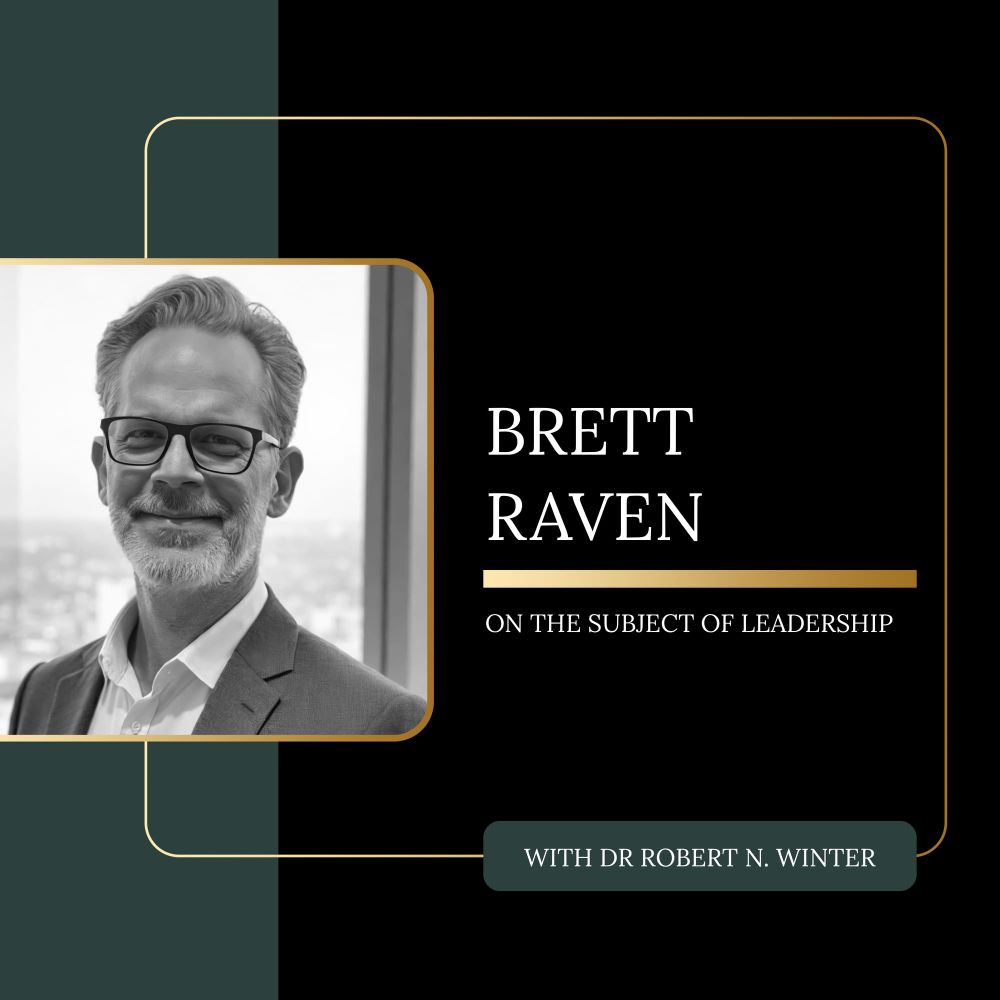
In this episode of On the Subject of Leadership, I speak with Brett Raven—a fractional chief information officer and principal of The Consulting CIO, who has spent twenty-five years being held accountable for precisely the numbers now under dispute. He has been chief technology officer inside fast-moving e-commerce businesses, rebuilding the platforms beneath them. He advised the C-suite at Salesforce on enterprise architecture. He led an experience-platforms delivery practice at Accenture across the Asia-Pacific region. He is now among the people an organisation telephones once a transformation has stalled and the reported metrics have quietly parted company with the business they purport to describe. His public position is blunter than his commercial interests would recommend: there is a bubble, and the pilots, the metrics, and the projections are not matching what survives contact with production.
I put the obvious objection to him early—that a man who sells AI advisory has peculiar reasons to talk the market down—and he neither retreated into vocabulary nor overstated his own certainty. Asked how the thing bursts, he said plainly that he did not know.
What follows are the ideas from the conversation I have continued to turn over since.
The Money Goes Around
Brett's bubble claim is not about capability. He builds software with these tools daily, trains executives in their use, and describes the underlying technology as real. His concern is the capital.
What he sees is circularity: money moving between hardware manufacturers, model developers, and the tooling layer that wraps them, in volumes and directions that make each participant's revenue partly a function of another participant's investment. Beneath it sits an unresolved problem of unit economics. A subscription costs the user twenty to two hundred dollars a month; the cost to serve, on his estimate, runs at some multiple of that. Forward revenue is booked against long-dated government and enterprise contracts. Fresh capital arrives to service present commitments. His phrase for the arrangement, used more than once, was kicking the can down the road.
Hyman Minsky (1919–1996) supplied the taxonomy for exactly this in his financial instability hypothesis. He distinguished three financing postures. A hedge unit meets interest and principal from operating income. A speculative unit covers interest but must roll its principal. A Ponzi unit covers neither, and must borrow or sell assets simply to meet its commitments, on the expectation that appreciation will eventually justify the structure. Minsky's crucial and frequently forgotten qualification is that Ponzi units in his sense are not frauds. They are ordinarily sincere firms whose revenues are genuinely anticipated—later. His argument was that a prolonged run of good outcomes shifts the population of firms toward the fragile end of that spectrum, because success discredits caution. Stability is destabilising.
Who Writes the Rules
Then Brett said the thing that has occupied me most since, and it was not about model developers at all. It concerned who ends up holding the position. He described a change in the treatment of newly listed companies such that a very large listing now enters the index funds almost immediately, exposing retirement savings to those valuations by operation of the mandate rather than by any decision a member made.
He was right in substance and imprecise in detail, and the detail is worth having, because it is a better story than the one he told.
Facing the prospect of listings by SpaceX, OpenAI and Anthropic, the index providers rewrote the rules. FTSE Russell confirmed on 26 May 2026, effective immediately, that sufficiently large IPOs may enter the Russell indices after the close of the fifth day of trading, replacing a quarterly review cycle that had produced a practical seasoning window of one to three months. Nasdaq had moved on 1 May, cutting the wait for its highest-ranked new listings from three calendar months to fifteen trading days and replacing its ten per cent float minimum with a weighting cap. Morningstar's CRSP indices, tracked by several very large Vanguard funds, introduced their own accelerated screen.
Observe what has just happened. A category of asset became large enough that the rules governing entry to the world's principal equity benchmarks were altered to accommodate it, within weeks, following consultations conducted with the bankers and issuers who stood to benefit. Passive capital did not choose this exposure; it was allocated the exposure by a change of definition.
And these are not regulators. Index providers are private firms selling a commercial product. There is no statutory process, no impact assessment requirement, no appeal, and no regulator with jurisdiction over benchmark methodology of this kind. Tim Büthe and Walter Mattli documented the general phenomenon in: a rising share of the rules that actually govern global markets is written by private bodies, and the determining question is not whether the rules are sensible but who is admitted to the room where they are made. Those excluded do not get a vote. They get the rules.
What the excluded did get, in this instance, was stationery. In June the New York State and City Comptrollers, together with the Illinois Treasurer and the Comptroller of Maryland—between them responsible for pension assets exceeding six hundred billion dollars—wrote to FTSE Russell and the London Stock Exchange Group asking them to pause the fast-entry rule until a formal investor impact analysis had been conducted, and to publish it if one already had been. A parallel letter went to Nasdaq, asking how a rule change affecting more than 1.4 trillion dollars of investor assets had been adopted without one. The London Stock Exchange Group declined to comment.
Two features of that letter deserve to be noticed. The first is its argument: that Nasdaq having moved did not oblige FTSE Russell to move, and that declining to follow was an available and defensible choice. The second is that it was proved correct almost immediately. S&P Dow Jones Indices consulted on cutting its own seasoning period from twelve months to six, and on 4 June 2026 declined—retaining the twelve months, the profitability screen, and the float minimum for the S&P 500 regardless of a candidate's size. One provider looked at identical pressure and refused. The change was therefore never necessary. It was a choice, and choices have authors.
This is a structure I have written about before under a different name. The people making the decision sit at maximum distance from its consequences, and those who will carry the consequences—superannuation members, holders of index funds they did not select—have no proximity to the decision whatsoever. The fiduciaries' letters are best understood as an attempt to reattach the two, undertaken by the only parties in the arrangement with no incentive to leave them apart. In an earlier letter to SpaceX itself, the same officials put the position with admirable directness: the company will become, through index inclusion, an unavoidable holding in their portfolios, and its governance ought therefore to meet the baseline that long-term institutional capital depends upon. That is the argument of people who have realised they will be made owners of something whether or not they judge it sound.
The Bubble That Lays the Track
Brett declined the easy version of the wider argument. Asked about the dot-com parallel, he made the point that the promise of that period was not met at the time and was met slowly afterwards—that the mania laid foundational capability the rest of us subsequently used without paying for it.
Carlota Perez (b. 1939) built a historical model on that observation. Each technological revolution, on her account, moves through an installation period in which financial capital chases the new technology with escalating disregard for earnings, a frenzy that ends in collapse, a turning point, and then a deployment period in which the overbuilt infrastructure is put to productive use at prices no rational investor would have accepted for building it. The canals, the railways, the dark fibre: the bubble is the mechanism by which societies finance infrastructure no disciplined allocator would fund.
If Perez is right, then "there is a bubble" and "this technology will reshape enterprise work" are not competing propositions. Her model requires both. That is a considerably more interesting position than the one usually attributed to sceptics, and it is closer to Brett's actual view than his headline suggests.
The pressure I would apply is this. Perez's turning point is neither automatic nor benign. In her account it is a political and institutional passage whose outcome depends on decisions taken while the wreckage is still warm—which is to say, on precisely the kind of decision the index providers have just demonstrated they take under pressure and at speed. Brett's forecast, of eleven or twelve significant model developers consolidating to perhaps six within eighteen months, is a prediction about the end of the frenzy rather than about what follows it. He was candid that he cannot see the mechanism of the unwind. I take that as a mark of seriousness. Everyone who claims to see it is selling something.
What the Fast Follower Is Following
Brett is relaxed about Australia's position. We learned something from the dot-com period, he argued; we are not jumping the gun on the promises other markets are swallowing; and although we occasionally feel outposted and behind, being a fast follower is the better place to stand.
I have some sympathy with this. Australian executives and directors are reliably described in surveys as sitting at the conservative end of the international distribution, and the description is reliably treated as an indictment. I think that is wrong. Genuine innovation is not indifference to risk; it is the accurate understanding of risk, which is what permits an organisation to move quickly through hazardous territory rather than blundering through it and leaving the wreckage for a successor.
But the argument depends entirely on what is being followed, and Brett himself supplied the reason to worry. Describing how boards form their expectations, he sketched a director who reads a consulting report about an American company that removed seven hundred people from its call centre through automation, retains the number, and returns to the table asking why we are not doing that.
The reference is unmistakable. In February 2024 Klarna announced, jointly with OpenAI, that its assistant was performing work equivalent to seven hundred full-time customer service agents, handling two-thirds of conversations, cutting resolution times from eleven minutes to under two, and heading for forty million dollars of savings. It was a global news event. In May 2025 the chief executive told Bloomberg the company had gone too far, that the focus on cost had produced lower quality, and that human agents were being rehired. That was an interview. Klarna now disputes the word reversal, noting that it never removed human support entirely and that its assistant's measured output has since grown—a qualification almost nobody who repeats either version of the story has encountered.
Note the asymmetry. The announcement was a press release issued jointly with the vendor. The correction was a remark. The contested status of the correction is effectively unknown. A follower who follows announcements is not a fast follower at all; he is a slow leader, arriving at the original error eighteen months late and without the first mover's data.
Paul DiMaggio and Walter Powell named the mechanism in 1983. Where goals are ambiguous and the environment generates symbolic uncertainty, organisations resolve the uncertainty by modelling themselves on others they take to be legitimate or successful. They called it mimetic isomorphism, and its product is convergence on a template rather than on a solution. Their identification of the principal vectors has aged with some cruelty: consulting firms and professional associations, precisely because they carry templates between organisations at scale and are rewarded for the carriage rather than for the outcome.
We have already watched this operate one level up. The pension fiduciaries' objection to FTSE Russell was, in substance, an anti-isomorphic argument—that Nasdaq's decision created no obligation to converge—and S&P's refusal demonstrated the point. Index providers copy each other under uncertainty for the same reasons boards do.
Which is the difficulty with Brett's optimism. Conservatism buys a lag; it does not determine what the lag is used for. Observation and imitation take exactly the same amount of time.
The Trophy on the Desk
Then the conversation descended from capital markets to the desk, and produced the most revealing detail of the hour.
Brett described organisations measuring individual employee productivity by token consumption. Staff are encouraged to spend; spending is recorded; aggregate usage is reported to the model provider, and the provider sends back an award for the desk. He was scathing, and correctly so: the metric translates directly into currency, so the operative proposition becomes that an employee who is not spending enough money is not doing their job properly.
Thorstein Veblen (1857–1929) anatomised this in 1899. His subject was conspicuous consumption—expenditure whose function is to evidence standing rather than to satisfy a want—and its companion, conspicuous waste, in which the honorific value of the spend derives precisely from its uselessness. Veblen's sharpest observation was that emulation propagates downward: the standard set at the top becomes the obligation of everyone beneath, long after anyone recalls what it was meant to achieve.
What distinguishes the token case from ordinary metric corruption is who designed it. The status economy here is not an unfortunate emergent property of a well-meant measure. It is supplied, complete with trophy, by the party collecting the revenue. Veblen would have found the perspex particularly satisfying.
Asked later which metric he distrusts most, Brett named hours saved, and asked the question that ought to accompany every such claim: where did the hours go? A figure for hours saved is an assertion about a counterfactual, and it is almost never accompanied by evidence that the reclaimed time was redeployed to anything at all. His constructive version inverts the usual framing—apply the technology to the organisation's inefficiencies rather than to its headcount, and start with the meetings.
The Dynamo and the Drive Shaft
Brett offered an image I have not been able to put down. He could, he said, sit with a chief information officer, open a coding tool, and in two hours produce a genuine three-tier application: secured, role-based, integrated, generating reports. He can do this. The trouble is what the room concludes from having watched it.
The extrapolation is immediate and nearly irresistible—if that took two hours, what might we have by Friday? And the answer, from a man who has spent a career conducting post-mortems, is that the technology was never the constraint. Asked what actually kills the projects he is called in to recover, he named two things, neither of them technical: expectation management, and change management.
Paul A. David (1935–2023) explained the mechanism in the best short paper written on the subject. Electric motors were commercially available from the 1880s. American factory productivity did not respond until the 1920s. The reason was architectural. Steam-era factories were organised around a central drive shaft: machines were positioned according to their proximity to power, and buildings ran to several storeys to keep the shafts short. Replacing the steam engine with one large electric motor changed nothing, because the layout was unchanged. The gains arrived only with unit drive—a small motor on each machine—which permitted single-storey plants laid out by the sequence of work, overhead materials handling, and eventually the moving line. That took roughly forty years, a generation of managers, and the demolition of the existing plant.
The two-hour application is a dynamo bolted to the drive shaft. Real power; unchanged layout; no gain.
This is why Brett's most unfashionable positions are also his most defensible. He does not think organisations need an AI strategy, and he does not think they need a chief artificial intelligence officer. He thinks they need an actual business strategy with measurable outcomes, laddered down through capabilities to the point where one can identify which capability, lifted, moves which number—and only then ask what might lift it. Sometimes the answer will be a model. Frequently it will be a process, or a person, or the removal of something. Beginning with the solution, he said, is the wrong way around in any technology implementation. It has been the wrong way around for forty years. The tooling has merely made it faster to get wrong.
Designed to Fail
The most contrarian thing Brett said, he said almost in passing, and it cuts against a position I have argued myself.
The widely circulated statistics on failed artificial intelligence pilots, he suggested, are largely measuring the wrong thing. Most pilots are designed to fail, in the sense that they exist to generate learning rather than to establish a business case. Judged as business cases they were never going to pass. An organisation that wants a pilot that scales should write a different brief.
James G. March (1928–2018) gave the underlying distinction its formal statement. He separated exploration—search, variation, experimentation, discovery—from exploitation, the refinement and execution of what is already known. His central finding was that the returns to exploitation are proximate, certain, and measurable, while those to exploration are distant, uncertain, and frequently negative, so organisations reliably over-invest in the former and starve the latter. An exploratory project assessed against exploitation criteria fails by construction.
So the first half of Brett's claim is sound. Where a pilot genuinely exists to test a thesis, counting it as a failed business case is a category error, and some proportion of the published failure statistics is doing exactly that.
The second half does not survive contact with how most organisations actually work. Exploration for its own sake is a luxury good. It requires a firm with the revenue to fund terminal projects, the governance to protect them from quarterly scrutiny, and the tolerance to see them end without a product. A handful of very large technology companies can do this. Almost nobody else can, and almost nobody else pretends otherwise at the moment of funding. In the ordinary firm the pilot is pitched, funded, and approved precisely as a gateway to a production capability. The business case is not a misapplied external standard; it is the reason the money was released.
Which means the low conversion rate is not a measurement artefact. It is closer to a smoking gun. If pilots were sold as pathways to production and did not reach production, then the failure is exactly what it appears to be, and its distribution across firms and sectors is the finding rather than the noise.
There is a further difficulty, and it is the one that ought to trouble a board. "Designed to fail" is available as an ex post description. A gateway pilot that does not convert can be reclassified, after the fact, as a learning exercise—and once that move is permitted, no pilot can ever fail. The organisation has acquired a mechanism for converting disappointment into wisdom at no cost, and the only thing it reliably learns is how to describe things. This is not a hypothetical failure mode; it is the ordinary language of the post-implementation review.
Brett's own prescription is, in effect, the remedy. He proposes funding these programmes in tranches, in the manner of a venture portfolio: a defined sum against defined goals, the next tranche released only on demonstrated value, with a named individual accountable for the outcome. Stated at the outset, that is what makes the difference between a pilot that is genuinely exploratory and one that has merely been relabelled. It is unglamorous, it is essentially a governance argument, and it is the correct answer.
The Hiding Hand
Asked which book he would put in front of every executive, Brett named one that is not about artificial intelligence at all: How Big Things Get Done, by Bent Flyvbjerg and Dan Gardner. Its subject is why large projects fail—optimism bias, poor forecasting, absent ownership, no governance model—and its most famous illustration is the Sydney Opera House, which Bent Flyvbjerg has documented at roughly fourteen hundred per cent over budget.
And then Brett said the thing that has stayed with me longest. The Opera House, he observed, has paid dividends over time—that we had, in a sense, a small Opera House bubble, and it was worth it.
He did not appear to notice that he had just changed sides.
That position belongs to Albert O. Hirschman (1915–2012), who named it the Hiding Hand. We systematically underestimate the difficulty of what we undertake; we equally underestimate our own ingenuity in surmounting difficulty once committed; and the two errors offset. Providential ignorance, on Hirschman's account, is what allows societies to begin projects they would never rationally start and could not afford to have foregone. Flyvbjerg's work is a sustained assault on precisely this idea—that the offsetting is largely illusory, that the Hand mostly hides, and that the survivors are visible while the abandoned wreckage is not.
Brett recommended the book that demolishes the position he had arrived at, unprompted, twenty minutes earlier. I raise it not as a gotcha but because the unresolved tension is the most useful thing a board could take from the hour. Both are defensible. Neither is decidable in advance. The question that separates them is not whether the forecast was optimistic—it always is—but whether the organisation retains the capacity to discover mid-flight that it was wrong and to act on the discovery. Which returns us to conversion, and to whether anything is ever actually decided.
Asked for the most underrated word in the discourse, Brett said accountability, and noted that it is the one most conspicuously missing. He had already supplied the illustration: the board that sets its executives a target of twenty-five per cent cost reduction through artificial intelligence, attaches the long-term incentive to it, and considers the matter delegated. That is not accountability. It is the transfer of consequence downward while the credit is retained above—the same structure as the index rules, at a different scale, and the reason both keep happening.
If you sit on a board that has approved an artificial intelligence programme you could not personally describe; if your organisation measures anyone on tokens consumed or hours notionally saved; if you have ever imported an overseas case study without checking whether its author still believes it; or if you hold a fiduciary position and have not asked who wrote the rules by which your passive holdings are selected, this conversation is worth your full attention.
Good night, and good luck.