
Somewhere in the wheat belt this season, a farmer will bring in several hundred hectares in the time his grandfather needed for a single paddock. He will do it largely alone, from an air-conditioned cabin, above a header that steers itself to within a few centimetres and measures the yield as it goes. Very little of what he does that week will be doing in the old sense. His work is deciding—when the moisture is right, when to shift paddocks, when an approaching front makes speed matter more than spillage. The doing belongs to the machine. The transition from doer to decider took his family three generations, and nobody along the way felt the need to give it a clinical name.
The same transition ran through every office in the second half of the last century, faster and rather closer to home. Within living memory, an executive did not type. He—because back then it almost always was a he—structured the argument, dictated it, corrected the draft, and signed it—the typing pool did the doing. The pool has since gone the way of the carbon copy, and the knowledge worker with a language model to hand is simply the newest occupant of a very old position: the person who decides while something, or someone, else does. Shoshana Zuboff watched an earlier instalment of the same shift among pulp-mill operators nearly four decades ago, as the work of hands became the work of judgement exercised upon screens.
I begin with the harvester, typist, and the pulp mill because the newest instalment has just acquired a diagnosis. Writing in Harvard Business Review, Guy Champniss surveys some 1,200 employees across the United States and Britain and reports an accumulating "psychological debt" wherever AI is adopted without regard for what its use does to human motivation. The debt comes itemised in six forms—cognitive, autonomy, competency, relatedness, credibility, and identity—each named for the thing employees feel the technology is taking from them: the habit of thinking, control over their work, confidence in their skill, connection to their colleagues, standing in the eyes of peers, and the sense of what makes their work theirs at all. Champniss' article has been received across the professional platforms with the reverent reposting reserved for anything that flatters an anxiety and supplies a list. I intend to spend five essays doing something less agreeable, which is taking it seriously. This is the first.
What Is Real in It
Let me concede at the outset what the article genuinely has. The feelings it documents exist. Nearly a century ago, William and Dorothy Thomas set down the maxim that if people define situations as real, they are real in their consequences, and it remains the most useful sentence in sociology for anyone who manages other human beings. An employee who feels deskilled behaves like a deskilled employee: hesitant, defensive, quietly disengaged. An employee who believes using the tool costs them credibility will hide use of it, with all the small corrosions concealment brings. It does not matter, for the manager standing in front of that person, whether "psychological debt" survives scrutiny as a construct. The experience is data, and it is data of exactly the kind managers are paid to work with. Whatever this series goes on to say about the framework—and it will not always be kind—that concession stands, and it is not tactical. A critique that dismisses the felt experience of ordinary employees because the survey housing it is shaky has misunderstood both the survey and the employees.
The Restructure Test
But real is not the same as new, and it is nowhere near the same as caused by the technology. Consider what an ordinary restructure does to a workforce, because most workforces no longer have to imagine it. The announcement arrives. The structure is dissolved, the roles are spilled, and the filling proceeds over months of ritualised uncertainty. Several decades of meta-analysis leave no doubt about what this costs: job insecurity reliably corrodes health, attitudes, and performance, and the damage done to those who remain after rightsizing is nearly as dependable as the damage done to those who leave. Now lay Champniss' six-item list against it. Competence is publicly re-examined. Autonomy is suspended for the duration. Working relationships are severed by organisational chart. Credibility is re-auditioned before a new manager. Identity is renegotiated against a box on a slide. The average restructure inflicts every form of the newly itemised "debt" at a single stroke, more deeply than AI has managed in three years, and nobody ever coined a metaphor for its myriad psychological effects. Instead, we called it transformation and expect managers to manage people through it.
The average restructure inflicts every form of the newly itemised debt in a single quarter, more deeply than AI has managed in three years, and nobody ever coined a metaphor for it.
That expectation was the correct one, and it supplies the method for everything that follows in this series. Where the diagnosis names a debt, I will name a failure, and locate its owner—in leadership, in management, or in governance—because a debt without an accountable debtor is not a liability but an alibi. One reassignment will serve for now as demonstration. The reflex to prompt before thinking, which the article calls cognitive debt and treats as the most discussed of the six, is not a psychological condition awaiting a mitigation programme. It is what happens when nobody in the room is leading the use of the tool. A manager who thinks aloud with the machine, who insists on a hypothesis before a prompt, and who treats output as material to be argued with rather than adopted, is modelling a practice; I have written elsewhere about using AI as a thinking partner without letting it think for you, and the discipline is learnable. Where that leadership is absent, offloading fills the vacuum, as it always has—the delegation upward of thinking is at least as old as the staff paper drafted so the general need only initial it. The debt is real. The borrower has been misidentified.
 Dr Robert N. Winter
The Typist Never Claimed to Think
Honesty requires the strongest objection stated at full strength, so here it is. The harvester does not offer opinions on agronomy. The typist typed what they was given, and an error in the letter was obvious to the person who signed it. The model is different in kind, not merely in speed: it produces fluent, confident, well-structured prose precisely at the frontier of its user's competence, which is the one place the user is least equipped to check it. A tool that takes over the doing is an old story with a long and mostly happy ending. A tool that performs the thinking—persuasively, and sometimes wrongly—has no exact precedent, and any account of the present moment that pretends otherwise is nostalgia wearing a tweed jacket. Whether that novelty rescues the psychological-debt framework, or instead exposes something rather less comfortable about the state of competence in the modern workforce, is the question this series must answer, and I will take it up directly in Part III.
This series runs to five parts. In the next article I examine what happens when a felt condition becomes a score out of one hundred, with an owner, a dashboard, and a budget line. In the third article I take up the frontier problem above: who can actually check the machine, and what the answer reveals. In the fourth I move to the boardroom, and to organisations that mandate adoption below decks while the bridge quietly exempts itself. And in the fifth I set out the remedy, which is the one a quarterly incentive structure is designed to punish. Parts two and three are free to members of the Commons; the final two are for the Inner Circle, whose patronage makes work of this kind possible.
The old complaint has new clothes, a survey instrument, and a score. What it has always lacked is someone willing to own it. Finding the owners is the business of the next four essays.
Good night, and good luck.
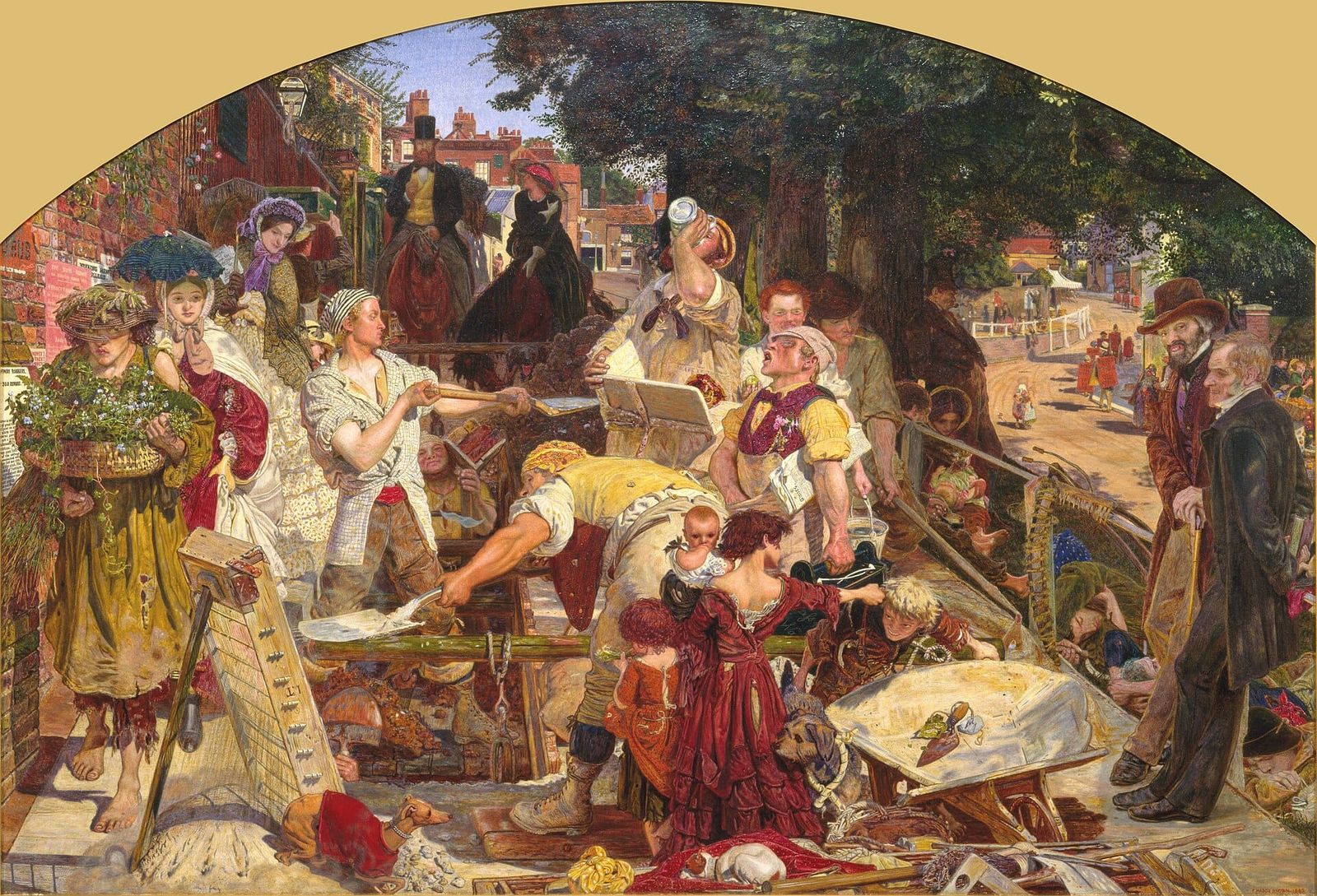
Work by Ford Madox Brown (1821–1893) is is licensed under Public Domain.