

What do you do with a system that worked?
The leadership literature is well supplied with accounts of systems that fail. Bad incentives, perverse metrics, cultures that eat their young: these are comfortable objects of study, because the moral is available before the analysis begins. The harder case is the system that succeeded. It hit its numbers, it promoted its winners, it produced the results it was designed to produce—and it also broke people, including some of the people it promoted. That case is harder because it cannot be dismissed as a design failure. It worked. The question is what a person does afterwards, having been both its beneficiary and its casualty.
The reason the question is rarely put well is that those best placed to answer it have every reason not to. People broken by such a system describe it as a machine for breaking people, which is understandable and incomplete. People who prospered describe it as a meritocracy, which is self-serving and also incomplete. The useful witness is the one who was both, and who is not selling either an indictment or a redemption story.
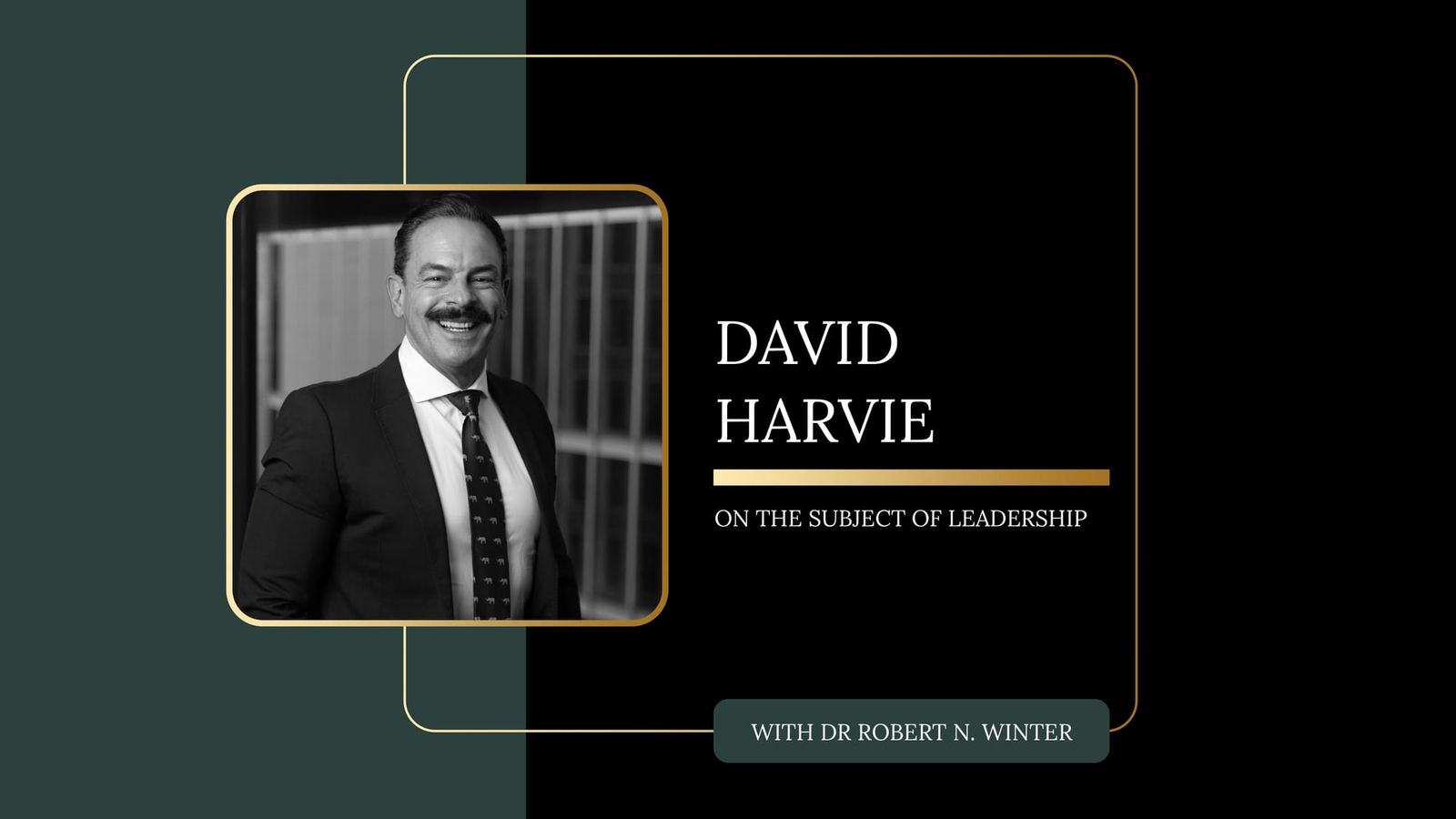
My guest this week is David Harvie, who after close to three decades in Australian financial services is now Director, Wholesale Distribution @ Ausiex.. Alongside that he has built DadBodz, a health venture aimed at time-poor fathers, and has since co-founded NEXUS Holistic Health. He and I studied leadership together as postgraduates, in an MBA seminar room where the philosophies were handed to us as objects of contemplation rather than instruments. He is one of the few people I could ask which of them survived.
What follows are the ideas from the conversation I have continued to turn over since.
Chevrons on the Shoulder
David grew up in far north-western New South Wales, the son of a bank manager, in a town where authority was distributed among a handful of visible men and one formidable headmistress: the sergeant, the publicans, the farmers, the president of the bowling club. He describes the primary school headmaster as a man who ruled with an iron fist and very little logic, his authority resting on the metaphorical chevrons on his shoulder and nothing else. What irked him as a child was not the severity. It was the absence of reasoning.
He reached for the German when he described it, and the reach was apt. Max Weber (1864–1920) defined Macht as the probability that an actor will carry out their own will despite resistance, regardless of what that probability rests upon, and Herrschaft as the probability that a command of given content will be obeyed by a given group (Weber, 1978, pp. 152–153). The distinction is not the flattering one usually assumed. Herrschaft is not a nobler species of power; it is the narrower fact of commands being obeyed—and the headmaster plainly had it. What Weber adds next is load-bearing. Material interest and habit make an unstable basis for obedience, so every system of authority attempts to cultivate a belief in its own legitimacy, resting on rational grounds: legal, traditional or charismatic (1978, pp. 324–339).
David’s claim is that the young people he now leads require the reasoning more than any cohort before them. It is the sort of generational assertion that ought to be received sceptically, and I know of no evidence establishing that this cohort differs in kind. But the underlying observation is sturdier than the generational framing, and it is Weber’s: authority that cannot account for itself is spending down a balance it did not earn.


Member discussion
The discussion is open to members of the Commons. Join, free, or sign in to take part.