Good morning, and welcome to this edition of The Scribbler. Given it is Easter, I thought I would take a moment to revisit my first intellectual love, history, and examine the notion of epochs. But first, a bit of trivia.
Trivia question: On this day the Labour party wins the 1966 United Kingdom general election. Who was the party's leader? Answer at the bottom of this scribbling.
This Edition's Scribbling
I am old enough to remember the teaching of history in epochs. Though much frowned on these days, as the fine disciplines of history, philosophy, and art, are jammed into the abomination that is 'social studies'—or worse social science—but epochs are effective in conveying the notion that periods in history can and do have themes and motifs.
Examples of this are echoed in the notions of Ancient Greece and Rome, the Dark Ages, the Middle Ages, the Reformation, the Age of Reason, the Age of Revolution, the Age of Capital, the Age of Empire, the Age of Extremes. These latter 'ages' were the titles used for Eric Hobsbawm's magisterial tetralogy on the long nineteenth century.
This may come as a deep shock to the 'woke' types you find on campus these days who think they have discovered that labels are often inaccurate, but even when the 'ages' approach was fashionable, anyone of even mean literacy was aware these terms are flawed. The Dark Ages, the preferred term now is Early Middle Ages, were in fact a period of burgeoning intellectual, artistic, and cultural life as nascent European nations sought to fill the power vacuum left by the collapse of the Roman Empire. The Age of Reason was frequently anything but reasonable. The Age of Democracy saw totalitarian regimes of the left and right abound.
While these flaws are readily pointed out on social media as pedants, invariably of a revisionist or negationist ilk, trip over themselves to criticise all who use such terms, there are many benefits to taking a sweeping approach to the teaching and understanding of history. This is because while it is seldom, if ever, the case that the lights are turned out on one age as another dawns, the way in which the New Year begins with the stroke of midnight, there are social events which ripple through time and broadly define a period. This approach often bears the ripest fruit when engaged with in the context of 'doom scrolling' on social media.
History, when viewed at a distance, feels certain. Unless you are in academic circles or part of a dedicated historical society, one can readily make and seldom be rebuked for an historical view when in conversation. Migrate that view to social media, particularly if it is a hot topic, and flame wars will quickly ensue. Take the less 'confrontational' approach and instead of expressing a view simply sit back and scroll, and the timeline is the intellectual equivalent of a dumpster fire. An autocrat in the Kremlin bent on the resurrection of Greater Russia. In China, an emperor clothed in the wonders of the digital age is attempting through the enforcement of tight social controls to stave off the chaos which always threatens life. While in the US partisan politics plumbs new depths as a septuagenarian brawls with an octogenarian over America's future. And this isn't even scratching the surface.
At Easter, a time in which Christians celebrate resurrection and life eternal, it is worth musing on an alternative reading of history which may not be to everyone's taste, but which offers a tantalising alternative to a more temporal reading of world events. The alternative reading in the Christian faith is often referred to as salvation history. The purpose of which is to try and effect eternal salvation offered by understanding the personal or everyday redemptive activity which goes on within human history.
In Salvation History we see the notion of 'Ages' or periods, as we did with the temporal Ages of Reason and Age of Revolution, but these spiritual epochs are expressed in the notions of:
Vexingly, Salvation History—although somewhat linear—does not overlay alongside world history. Rather, it is a reading of the historical record that happens inside the events and timelines of the world. A religious or, as we shall come to in a moment, a moral narrative for the inner workings of the events which represent an additional dimension in which humanity is engaged. If we can but see it.
Though it varies between traditions—Anglican, Lutheran, Methodist, Moravian, Reformed, Roman Catholic — the Easter Triduum or 'Three Days' (Latin: Triduum Paschale) takes believers from Maundy Thursday, through Good Friday, and culminates in the proclamation of the Lord's Resurrection. A procession of events which illuminates what Christian's believe is the definitive revelation of history. In this way, Easter is more than a celebration, it is a proclamation that what is recorded in the pages of history is but a part of what is really there. Within each page of our story, there is a sub-text or inner working — an esoteric meaning—of what God had intended for His creation since the beginning of time. Often referred to as the Logos or Word, it represents that through which all things came into being. A Word which became flesh, preached, suffered, and was resurrected to grant life everlasting.
For Christians, Easter represents an addition to the scientific or purely historical understanding of time. One in which there is more than the inevitability of our sun becoming a red giant in the future, and instead reveals a Lamb of God who takes away the sins of the world.
One does not need to be Christian to share in this message because it is a message of hope for humanity. Something more than eternal nothingness and in which our choices can reveal or obscure, can create or destroy, can save or condemn, can sanctify or defile. In short, can offer hope for a better tomorrow or lead to a nihilistic dystopia.
While our own short lives may lack the eternality of the Holy Spirit—a concept shared by many faiths—we can transcend events by our choices. Choices which, religious or not, have deep and long lasting moral implications. My choices aim for renewal, growth, and hopefully salvation. What are yours?
Article Selection: History
As 'An' Historian
Modernists may disagree, but if challenged by these dangerous revolutionaries, refer them to the below and the glorious roots of our language.
 Dr Robert N. Winter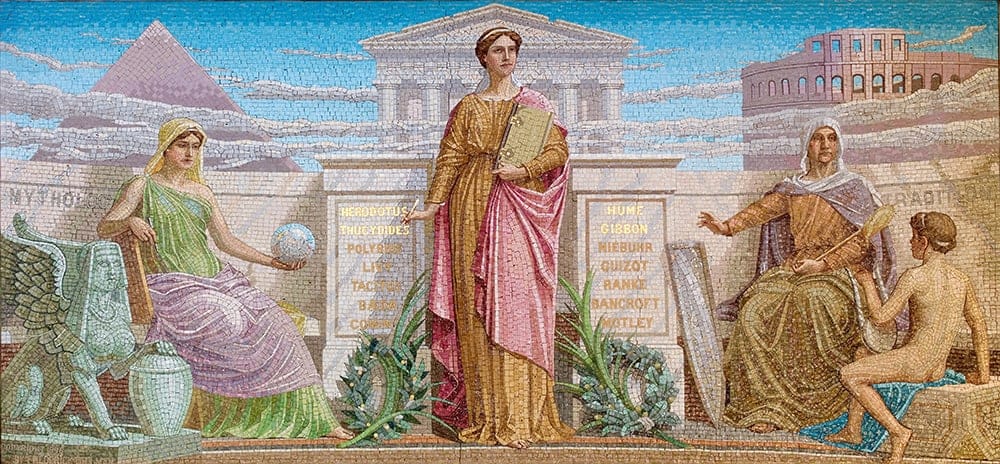
Autodeleting the Public Record
Rage if you will and burn screen time if you like — I simply accept if I want my thoughts to be personal and private then I ought not post them online.
 Dr Robert N. Winter
Twas Gunpowder Treason Day
As late as 2015 in Great Britain, Royals who married Catholics were removed from the line of succession, and Prime Ministers avoided disclosing their Catholicism in office.
 Dr Robert N. Winter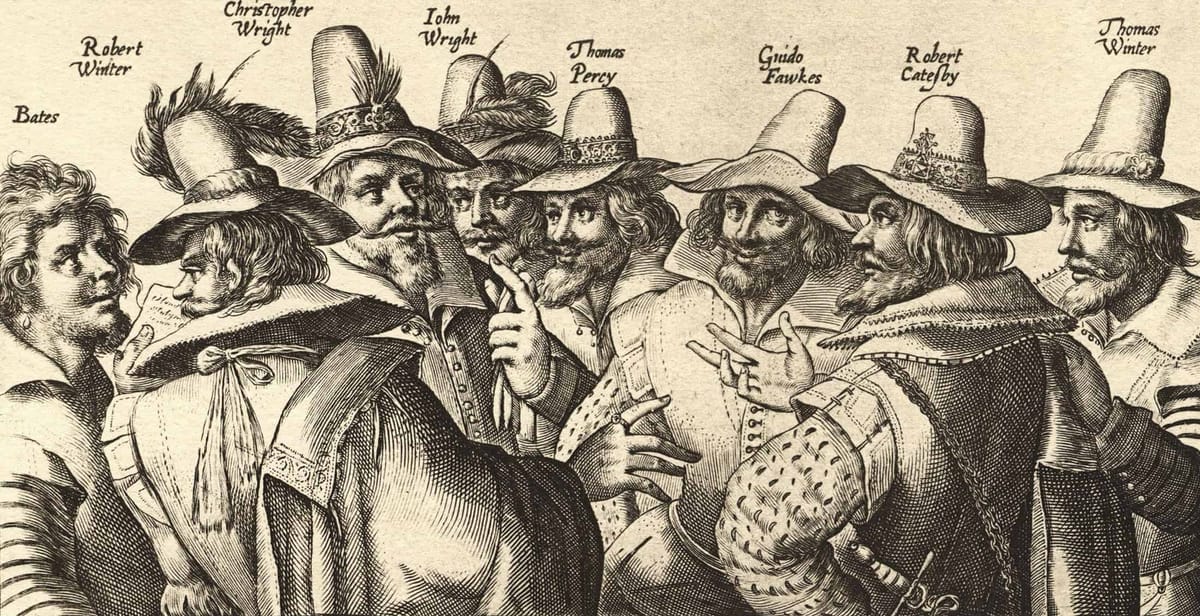
Art and About
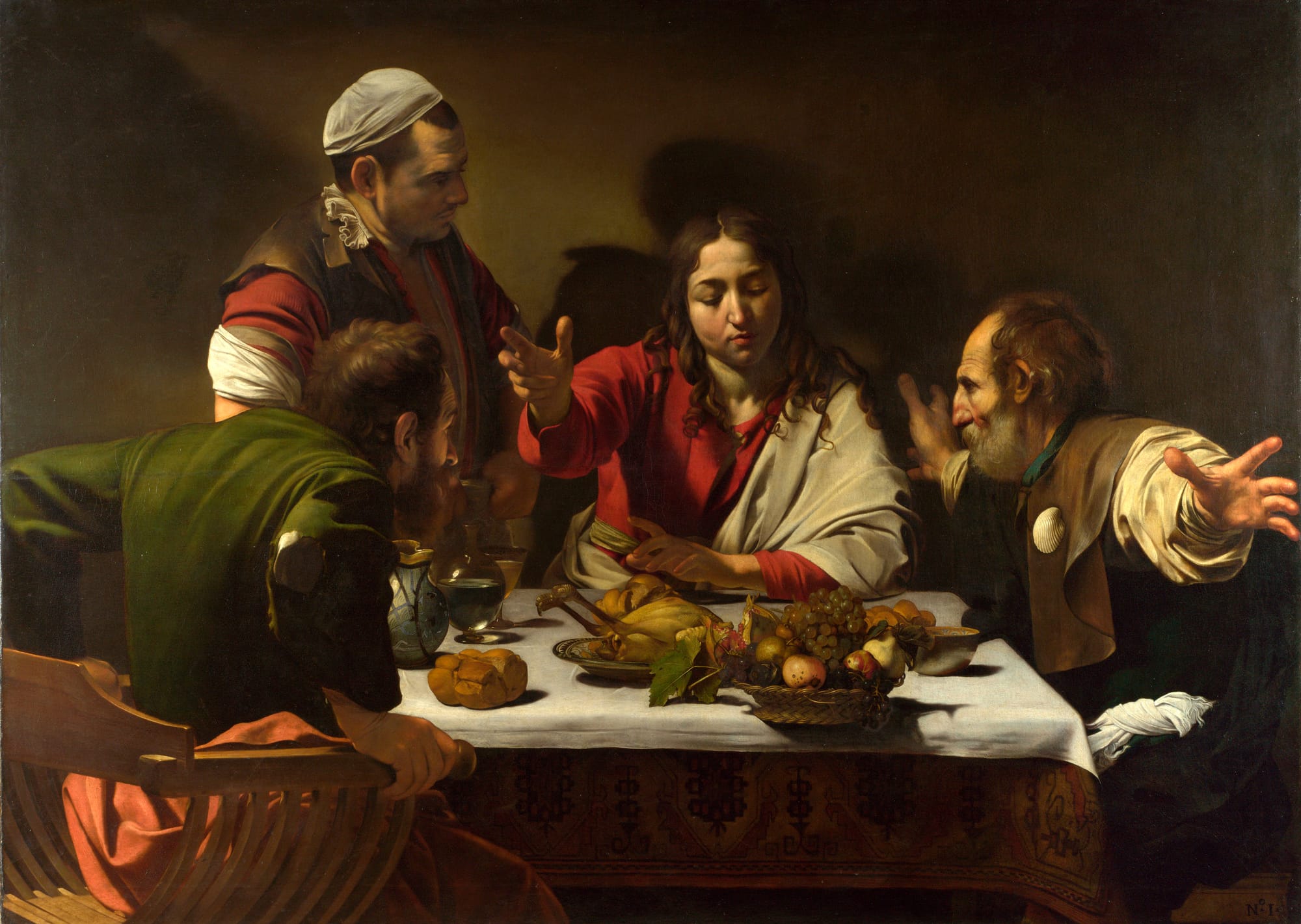
The Supper at Emmaus is a painting by the Italian Baroque master Caravaggio, executed in 1601, and now in London. It depicts the Gospel story of the resurrected Jesus's appearance in Emmaus. In the Gospel of Mark (16:12) Jesus is said to have appeared to them "in another form", which may be why he is depicted beardles.
The basket of fruit in the foreground has two stray strands of wicker that form an ichthys, the early Christian fish-symbol for Christ. The shadow of the fruit on the tablecloth forms the body of a fish and fishtail.
The Supper at Emmaus by Caravaggio is licensed under Public Domain.
Trivia Answer
Trivia question: On this day the Labour party wins the 1966 United Kingdom general election. Who was the party's leader?
Answer: Harold Wilson.
Additional Trivia: This was the last British general election in which the voting age was 21; Wilson's government passed an amendment to the Representation of the People Act in 1969 to include eligibility to vote at age 18, which was in place for the next general election in 1970.
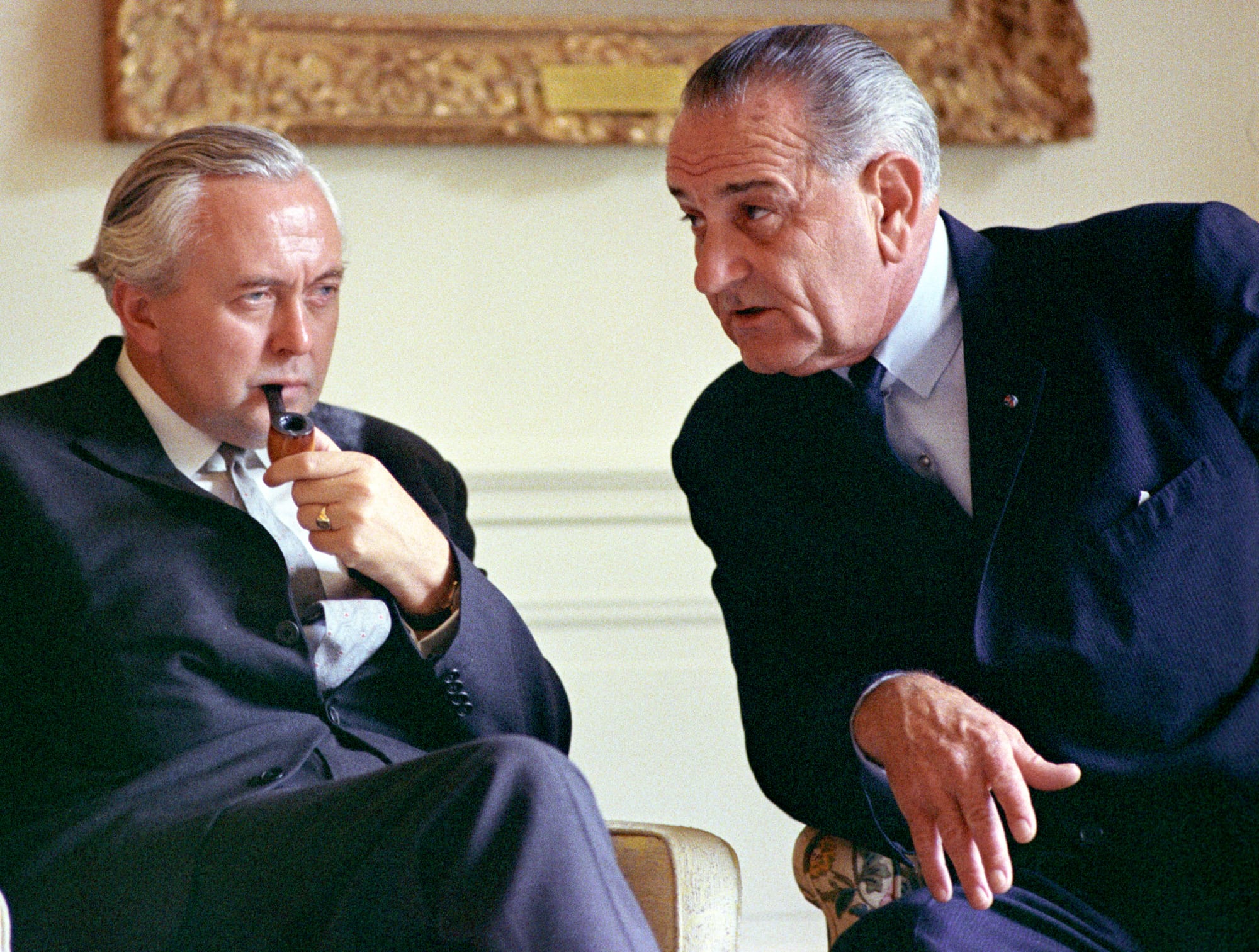
Harold Wilson (left) with US President Lyndon B. Johnson at the White House in 1966 by Yoichi Okamoto is licensed under Public Domain.