

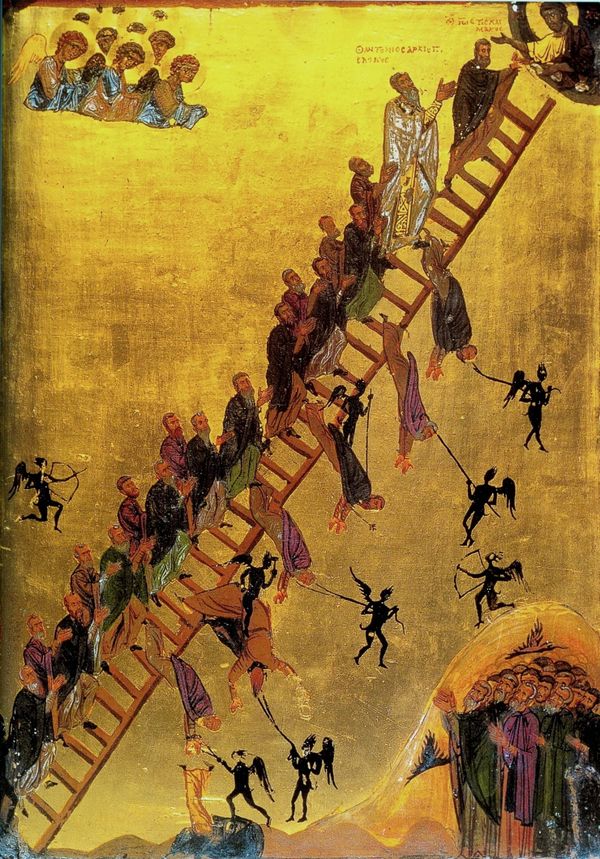
The leadership literature, and the organisations that consume it, share an unexamined assumption about direction. Progress means ascent. One begins as an individual contributor, demonstrates competence, and is rewarded with the management of others; from there the ladder continues upward through seniority into the executive, and the person who has climbed furthest is presumed to have succeeded most. The model is so pervasive that its alternatives are barely legible. To decline the next rung, or to take it and step back, is filed under a small and unflattering set of headings—a failure of nerve, a shortfall of ambition, burnout, a ceiling reached. What the filing rarely admits is a further possibility: that the rung was simply the wrong shape for the person standing on it, and that recognising as much is an act of judgement rather than a confession of defeat.
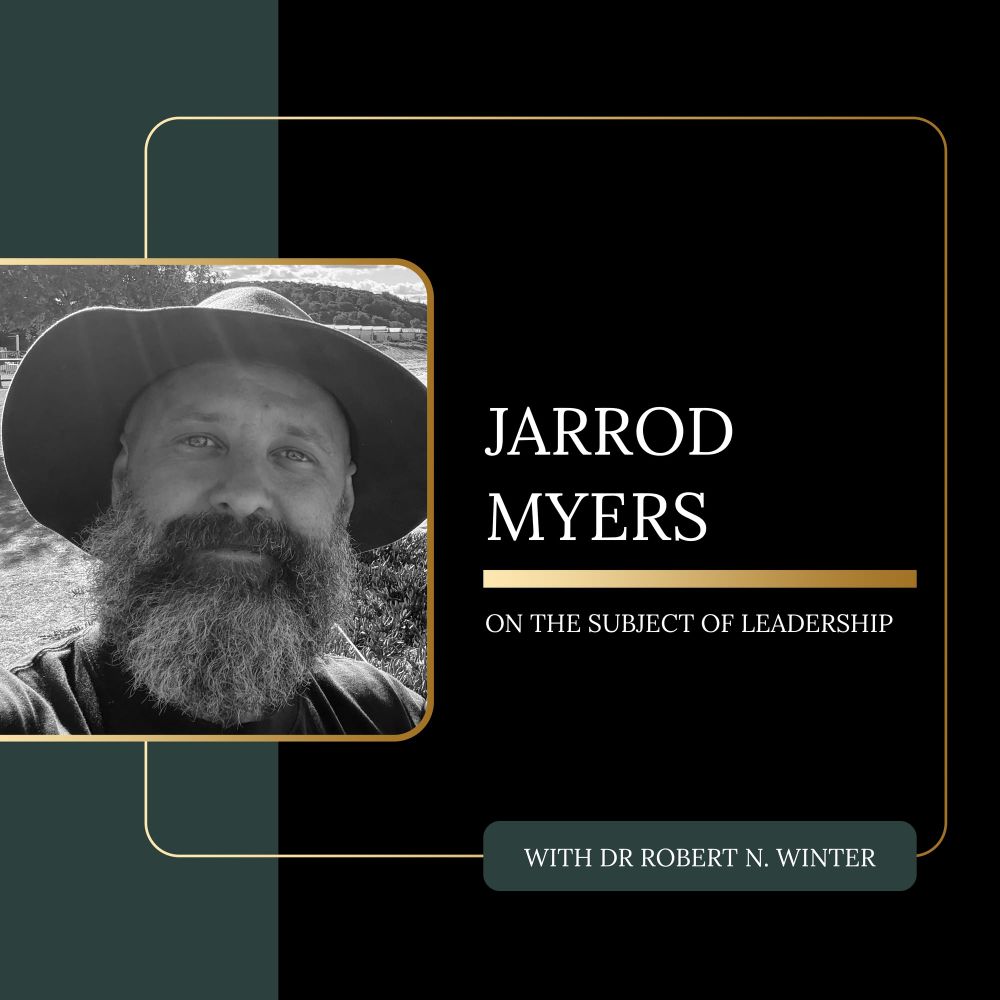
Jarrod Myers now runs his own venture. When we spoke he was a strategic accounts director at a Salesforce partner and AI consultancy operating across the ANZ region, and had held the more senior title there—Head of Sales—before giving it back: he tried management for a year, concluded it was the wrong fit, and returned to individual contribution without leaving the firm or, by his own account, leaving leadership behind. He has since left it altogether to build something of his own. Before technology there was the better part of a decade in social work and international development; before that, representative Australian football to the edge of the professional game. It is an unusual set of coordinates, and the line that runs through them is not a career plan—Jarrod is candid that he cannot write a long-term goal to save himself—but a consistent instinct about where his particular capacities do their best work.
What follows are the ideas from the conversation I have continued to turn over since.
The ceiling and the work
Jarrod's account of sport is disarmingly free of the usual mythology. He played two half-seasons with the Sydney reserves alongside players who went on to distinguished careers, and he is precise about why he was not one of them: he was never the quickest, tallest or strongest, and the athletic gifts that would have carried him further were simply not there. What he had instead was an unusual willingness to work—to keep running when fitter players stopped, to grind at the parts of the game that lay outside natural endowment. His summary is that you do not have to be the best; you have to work far harder than most, and that will take you a long way, though not, he adds, all the way.
That last qualification is where the science becomes interesting. The most influential account of expertise we possess belongs to K. Anders Ericsson (1947–2020), the Swedish psychologist whose 1993 paper with Ralf Krampe and Clemens Tesch-Römer, The Role of Deliberate Practice in the Acquisition of Expert Performance, gave us the concept of deliberate practice and, at second hand through popular writers, the ten-thousand-hours rule. Ericsson's claim was strong: that the gap between the expert and the rest reflects accumulated deliberate practice rather than innate talent, with height among the few genuine exceptions. It is a democratic and appealing thesis, and Jarrod's working life is a partial vindication of it—sustained, unglamorous effort has plainly carried him past more gifted people who did not bother.
But it is only partial, and Jarrod knows it. He names the ceiling that Ericsson's strongest formulation tends to elide—the athletic gifts he lacked, which no quantity of practice was going to supply. The evidence of the last decade has drifted toward Jarrod rather than Ericsson; the meta-analyses find deliberate practice a powerful contributor to performance but a long way from the whole of it. The honest position is the one Jarrod holds by instinct: effort is the ninety-five per cent that lies within your gift and that most people never fully spend, and it is worth spending precisely because it proves decisive so much more often than talent does. The ceiling is real. Almost nobody reaches it.
The year he ran sales
The centre of the conversation is the year Jarrod spent as Head of Sales. He did not fall into it; he argued for it, building the case in a presentation to his chief executive and board that the company had outgrown a model in which the founder was the boss of everything, and proposing himself for the role. They agreed. And then, in his own memorable audit, he was good at perhaps three or four of the ten things the job required, adequate at another three or four, and poor at the rest—and worse, he disliked several of the things he was poor at. He returned to individual contribution within about a year, with what he describes as relief on both sides: he had spared them the awkwardness of removing him from a role he was performing, by his own estimate, thirty-five per cent brilliantly, thirty-five per cent acceptably, and thirty per cent terribly.
The most precise diagnosis of what went wrong belongs to David McClelland (1917–1998), the American psychologist whose 1961 book The Achieving Society established the need for achievement as a distinct motivational drive. McClelland separated the need for achievement—the desire to accomplish, to meet a standard, to see a task through personally—from the need for power, the desire to influence and direct others. The distinction matters because, as McClelland argued directly in the years that followed, the two sit together uneasily in a manager. The high achiever is driven to do the thing himself and to feel the result of it; confronted with an underperforming subordinate, his instinct is to take the work back and close it out, which is precisely the thing a manager must not habitually do. Jarrod describes this failure mode without the vocabulary: a competitiveness he rates, only half-joking, at the hundredth percentile; a reflex to seize any deal that showed a chance of being won; a discovery that doing the work for people is not how you teach them to do it. He is not a man of low power-need who failed to reach for authority. He is a man of overwhelming achievement-need, for whom authority over others was a tax on the thing he was actually good at.
There is a second, quieter lesson in the same passage, one Jarrod's coach put to him bluntly: short of severe trauma, people do not change their fundamental make-up across a working life. The personality research broadly sides with the coach. The disposition that made Jarrod a poor delegator was not a skills gap to be closed with training; it was closer to a fixed parameter, and the intelligent response was to build a working life around it rather than against it. That is what stepping back represented—not surrender, but the alignment of the work to the person.
Disconnected from the consequences
Jarrod's decade before technology was spent in places most executives never see: the slums of Bangkok, the housing-commission estates of Sydney's west, where his closest working contacts included men who moved between employment and prison with a regularity no amount of goodwill could interrupt. He tells a story about a man who helped him move house, carried a refrigerator in unaided, and was back inside a week later, having held up a service station with a fake shotgun—because the lawful alternative paid seven dollars an hour. He does not tell it for effect. He tells it as the source of a perspective he has carried into corporate life: a sense of proportion about what a bad day at work actually is, and a corresponding impatience with leaders who have lost it.
This is where the conversation turned to a structural question that has occupied better minds than either of ours: why the people who rise are so often not the people who should. Jarrod's answer is that the ascent selects for a willingness to play a political game—for a certain relish in the manoeuvring—and that this quietly weeds out those who simply cannot bring themselves to say something other than what they think. The most rigorous treatment of that claim is the fieldwork behind Moral Mazes, the 1988 study in which the sociologist Robert Jackall spent years inside American corporations mapping how managers actually think. Jackall found that success in the managerial hierarchy had remarkably little to do with the quality of one's work and a great deal to do with alertness to what the person above you wanted, with fealty to patrons, and with a certain flexibility in one's moral accounting. The subordinate who raised objections too often was not promoted for his honesty; he was labelled a naysayer and quietly stranded. What Jarrod observed from the inside, Jackall documented from the field: hierarchies do not reliably reward the honest, because honesty is frequently inconvenient to the people who control ascent. This is not a lament about individual villainy. It is an observation about what a certain kind of structure selects for.
Leadership without a title
If the ladder selects poorly, and if the rung above was the wrong shape, the remaining question is the interesting one: what is left of leadership for a person who has deliberately declined authority? Jarrod's answer is that leadership was never the same thing as authority, and that he leads now in a way that requires no one to report to him.
The scholar who made this distinction his life's work is Ronald Heifetz, whose 1994 book carries a title this programme could almost have borrowed—Leadership Without Easy Answers. Heifetz's central move is to separate leadership, which he treats as an activity, from authority, which is merely a position. Authority is the formal power to direct; leadership is the work of mobilising people to confront difficult problems, and it can be exercised, in his account, with or without authority—sometimes more freely without it, since the person who holds no formal power is not trapped defending it. Jarrod's version is less theorised but recognisably the same: the individual contributor who builds culture, who fixes a process the customers are frustrated by rather than merely complaining about it, who contributes to decisions well outside his job description, is leading. He reaches for a numerical metaphor—the colleague who does the job to specification is a one; the colleague who does that and lifts the people and systems around him is a 1.2 or a 1.5—and the arithmetic, whatever one makes of it, points at Heifetz's distinction. The value such a person adds is leadership by any serious definition; it simply does not appear on an organisational chart.
It is worth resisting the sentimental version of this idea, and to his credit Jarrod does. Leading without authority is a genuine phenomenon, but it is also a phrase that can flatter a mere absence of authority into a principled choice. The honest test is whether the influence is real—whether the process actually changes, whether the decision actually shifts—or whether it is only proximity to a decision that someone else is making. Jarrod's claim survives the test because it rests on output rather than on self-description, which is the only ground on which it can survive.
What a manager is actually for
The counterpart to leading without authority is understanding what authority is properly for, and here the conversation produced one of its sharper exchanges. The trap for the high performer who becomes a manager is that he carries his competitiveness into the wrong arena—he tries, as I put it to Jarrod, to win the one-on-one meeting, to demonstrate that he is the best manager his report has ever had, when the entire purpose of the meeting is the report's development and not the manager's performance. Jarrod's recognition was immediate and rueful: that, he said, is exactly why he was so poor at it. He had to win, and there is no way to be a good manager whose private measure of a subordinate is whether you have out-performed him.
The deeper point is that management is not a side hustle. Organisations routinely take their best salesperson or engineer, hand them a team, and leave them to discover that they now hold two full-time jobs and have time for one—whereupon the technical work, being the more familiar and the more immediately rewarding, wins, and the management is done in the margins if at all. Jarrod's decision to step back reads, in this light, not as a retreat from responsibility but as a refusal to perform management badly in the gaps between doing the work he was hired for. There is more organisational honesty in that refusal than in most of what passes for ambition.
A marriage, not a date
The last idea I have kept is the one that most cleanly connects Jarrod's disparate lives. He does not, he says, sell in the transactional sense; he has never in his life asked what the close plan is or who needs to sign, retained no formal sales training that survived his attention, and cringes at the scripted call. His work is the long relationship—a consulting engagement measured in years, in which something will inevitably go wrong and the only thing that carries you through the wreckage is whether the relationship beneath it is real. It is, in his phrase, more like a marriage than a date. If you would not have a coffee or a beer with the person, he asks, what exactly is the point?
The scholar who dignifies this instinct is Richard Sennett, whose 2008 book The Craftsman recovered an old idea: that craftsmanship is the desire to do a job well for its own sake, a form of engagement with the world neither reducible to reward nor separable from a long apprenticeship to the material. Jarrod's contempt for the script is a craftsman's contempt—the script is the enemy of the responsiveness that only competence permits, and the person who cannot leave the script is usually the person who cannot answer the follow-up question. His pleasure in the long client relationship is the craftsman's pleasure in work that does not resolve on Friday. And his closing philosophy—that the top of the ladder is not the corner office but a life with more smiles than frowns in it, and that the climb, pursued for its own sake, is a bad map—is craftsmanship applied to a career. Sennett would recognise the instinct: that a thing done well, slowly, in the company of people you respect, is not a consolation prize for failing to ascend. It may be the point that ascent was always meant to serve, and usually forgets.
Who should listen
This is a conversation for anyone who has been promoted into a role that fits them poorly and suspects, quietly, that the honest move is backwards; for the manager watching a gifted individual contributor being marched toward a job that will waste them; and for the executive who has never seriously asked whether the ladder is the only shape a career can take. It will be of particular use to those who lead sales organisations, and to boards weighing how they promote, because it names a failure mode—the achiever who cannot delegate—that the usual incentives actively manufacture. It is not a comfortable conversation, and it offers no formula. But it takes seriously a possibility the field prefers to ignore: that stepping down can be the most clear-eyed thing a person does.
A postscript the conversation could not have known it was building toward: since we recorded, Jarrod has stepped away from the firm altogether and struck out on his own, under a banner that will need no gloss for anyone who has heard him on the subject of scripts. He has called it Off Script Ventures.
Good night, and good luck.


Member discussion
The discussion is open to members of the Commons. Join, free, or sign in to take part.