
Doing Less with More
My guest this week is Tim Newbold, founder of OKR Quickstart, who has spent a decade watching goal-setting frameworks meet real organisations, and who argues that when they fail, the fault is almost never in the framework.
On how organisations are built, changed, and quietly undone by their own structure.
My guest this week is Tim Newbold, founder of OKR Quickstart, who has spent a decade watching goal-setting frameworks meet real organisations, and who argues that when they fail, the fault is almost never in the framework.
My guest this week is Pamela Wyatt, Head of Business Transformation for Asia-Pacific at DT Global, who spent nearly a decade at the Asian Development Bank negotiating governance reform with Pacific governments.
My guest this week is David Harvie, Director of Wholesale Distribution at AUSIEX, a wholesale broker serving financial advisers and institutions, and the founder of DADBODZ, a health venture for time-poor fathers.
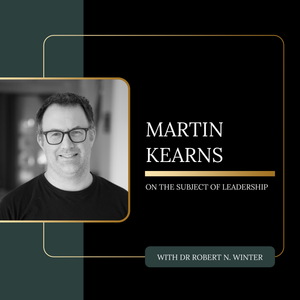
What happens when a movement built on autonomy becomes a system of rituals? In this episode of On the Subject of Leadership, I speak with Martin Kearns—one of the
Flat organisations are usually presented as a philosophy. More often they are a headcount. The literature on networked teams and post-hierarchical work is written, almost without exception, from firms
In an uncertain employment landscape, context matters. Work serves the organisation, not individual agendas. When employees and managers act in good faith and meet their obligations while preparing for multiple futures, organisations become healthier, more stable, and more effective.
When we judge the principle 'be right a lot' on inputs rather than outcomes we can make rational choices about the future, secure in the knowledge that we have positioned rather than predicted our future, that our future is based on skill and not luck, and that we are people worth following.
Although we cannot know what tomorrow brings, we can use a pattern recognition approach to lower risk and devise stronger strategies. This is because while it is nearly impossible for us to predict one specific future, we can confidently position for multiple probable futures.
John Boyd’s OODA Loop—observe, orient, decide, act—highlights agility, context, and speed in decision-making. Challenging linear models, it shows why adaptive thinking is critical to leadership and organisational success.
Effective governance depends on capabilities shared by managers and informal leaders, recognising that risk, strategy, and culture are inseparable. This calls for rethinking traditional governance models—and the rise of the governor-manager.
Seeing organisations as complex social systems highlights governance as a cultural force. Responsibility extends beyond senior leaders to all managers, shaping behaviour through clear standards, accountability, and consistent leadership practice.
Governance allocates authority, responsibility, and decision rights. When it is remote or sealed off from scrutiny, power goes unchecked, accountability erodes, and resource decisions become arbitrary and subjective.
Reframing so-called “negative” people as pragmatists exposes unchecked optimism as a driver of the sunk cost fallacy—loss aversion, ego, and false hope. Drop the Kool-Aid, face reality, and better decisions come into view.
When managers fall into the sunk cost fallacy, more data rarely helps because the problem is emotional, not rational. Biases like ego, loss aversion, and optimism drive persistence. Awareness, governance, and decisive leadership matter more than analysis alone.
Ever get the sense that the meeting you are in is more about appearances than actions? Find that people keep on raising decision items that were already settled? Notice irrelevant issues dominate the agenda? Quite possibly an aspiring CIA operative is sabotaging your meeting.
A crisp document should be narrative and substantial, not slides. As Bezos argues, six-page memos beat PowerPoint, which sells rather than thinks. When meetings reward persuasion over reasoning, organisations get polished form but weak substance.
Organisations that are above average in their track record of developing leader-managers put an emphasis on creating challenging opportunities, not just for aspiring talent but for incumbent Line Managers who can too easily become stale.
By leveraging the management tool of control to harness the energy released by the leadership tool of motivation, the informal leadership networks that arise can handle the greater demands that result from the organisational change process.
When alignment and planning are conjoined, the process releases untapped potential. This is because a leader-manager is energising people by unlocking feelings of autonomy, competence, and relatedness. An approach that ultimately leads to greater wellness.
Competent planning is a vital reality check on exuberant strategy, and sound strategy gives planning the direction to bring about change.