
Doing Less with More
My guest this week is Tim Newbold, founder of OKR Quickstart, who has spent a decade watching goal-setting frameworks meet real organisations, and who argues that when they fail, the fault is almost never in the framework.
On judgement, authority, and the exercise of leadership—as distinct from management, and rarely as tidy as the literature pretends.
My guest this week is Tim Newbold, founder of OKR Quickstart, who has spent a decade watching goal-setting frameworks meet real organisations, and who argues that when they fail, the fault is almost never in the framework.
My guest this week is Pamela Wyatt, Head of Business Transformation for Asia-Pacific at DT Global, who spent nearly a decade at the Asian Development Bank negotiating governance reform with Pacific governments.
My guest this week is Professor Alistair Noble, President of Nan Tien Institute, a small independent higher education provider near Wollongong grounded in Buddhist values.
My guest this week is David Harvie, Director of Wholesale Distribution at AUSIEX, a wholesale broker serving financial advisers and institutions, and the founder of DADBODZ, a health venture for time-poor fathers.
My guest this week is Jay Fontanini, founder of the AI Executive Accelerator, who spent three decades in property and casualty insurance before turning to building software and teaching executives to think with it rather than perform having thought.
There is a familiar shape to the discussion of artificial intelligence in Australian enterprises. Adoption figures rise. Pilot counts rise. Licence spend rises. Somewhere in the annual report a paragraph
The leadership literature, and the organisations that consume it, share an unexamined assumption about direction. Progress means ascent. One begins as an individual contributor, demonstrates competence, and is rewarded with
Most conversations about corporate governance begin with structure—committees, charters, the machinery of oversight. This one begins on the side of a dirt road in Nepal in 1999, and I
Most conversations about artificial intelligence and the product manager begin by asking whether the role survives. This one begins somewhere more useful: by asking what the role was ever actually
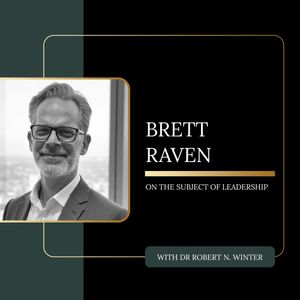
In this episode of On the Subject of Leadership, I speak with Clare Kitching, founder of Cambiq Consulting—formerly of McKinsey, QuantumBlack, and Treasury Wine Estates where she served as
What does it actually take for a strategic intent to survive contact with the business that must implement it? In this episode of On the Subject of Leadership, I speak
People accountable to a superior whose views they know tend to adopt those views. Nick Hassett on how accountability cultures manufacture silos, why agreement stops at the boardroom door, and why banning AI hides the risk rather than removing it.
What happens when a leader who sold the vision steps back into the reality of delivering it? In this episode of On the Subject of Leadership, I speak with Craig
What happens when a movement built on autonomy becomes a system of rituals? In this episode of On the Subject of Leadership, I speak with Martin Kearns—one of the
What separates a commitment from a preference? A preference is what an organisation would like to do. A commitment is what it has arranged to be unable to stop doing.
Flat organisations are usually presented as a philosophy. More often they are a headcount. The literature on networked teams and post-hierarchical work is written, almost without exception, from firms
Leadership cannot be reduced to neat models. Simple frameworks miss the deeper dynamics between leaders, followers, and purpose. While styles vary by context, effective leaders rely on consultative, supportive behaviours that build psychological safety and sustain long-term growth.
“They don’t know what they don’t know” captures a core leadership risk. Unaware managers make poor decisions and damage morale. Organisations that embrace learning, critical thinking, and ethical judgment build more resilient and just systems.
The first in a series on learning from history and its value for organisational decision-making. Today, those who draw lessons from the past risk being labelled “on the wrong side of history,” much as dissenters in business face exile for challenging dominant narratives.
Overconfidence distorts managerial decisions, fuelling poor strategy and ego. Shifting from prediction to preparation, grounding judgment in rational thinking, and valuing informed anecdote alongside data helps balance confidence with pragmatism and improves organisational outcomes.
Organisations that are above average in their track record of developing leader-managers put an emphasis on creating challenging opportunities, not just for aspiring talent but for incumbent Line Managers who can too easily become stale.
By leveraging the management tool of control to harness the energy released by the leadership tool of motivation, the informal leadership networks that arise can handle the greater demands that result from the organisational change process.
When Line Managers lack the hard skills of process design and implementation, the capacity to initiate changes in procedure, or the ability to write sound policy, and instead try to *lead* their team to success by hiring or co-opting other managers in the business to solve their problems, an engine
Informal leadership works best through small, closed ties of three people, combining trust and task focus. When ties are only bilateral or too numerous, informal leadership weakens and can undermine organisational effectiveness.
Informal leadership is most effective when conducted with a small number of closed ties (involving three people) and a mix of friendship- and task-orientated activities. When the ties are open (involving only two people) or become too numerous, informal leadership begins to break down and can hinder
A good CoS helps a leader achieve their potential in a sustainable way that delivers long term success when managing complex organisations.
As our adaptability mindset strengthens, resilience will also improve because individuals and teams are better equipped to absorb shocks today and use the energy to bounce forward into sustainable growth tomorrow.
When leadership is exerted in this form, organisations become increasingly accountable, agile, and autonomous — all the while operating at scale. At this point, an organisation can truly be described as 'purpose-driven' — a genuinely awesome competitive advantage.
This approach yields good, if imperfect, OKRs while advancing real management: pushing teams beyond comfort to learn, improve, and explore—driving meaningful transformation and unlocking organisational value.
By reframing the leadership models presented, propositions for managers can be advanced to enable better leadership of people with GenMe attitudes.
Given the obvious dichotomy in this approach to work generations, the practical implications for management are that the leadership theories many have encountered will struggle to provide solutions when it comes to developing coherent teams.